What if the greatest museum has no walls, no gift shop and no queue at the door? A reflective essay published by Daily Sabah argues that art history is less a story of invention than one of discovery — and the places that prove it are ones travellers walk through every day.
The piece opens with a simple observation: painters, architects and sculptors never begin from nothing. Colour precedes the painter, stone precedes the sculptor, light and proportion precede the architect. Creativity, in this view, starts with recognition — learning to see what was already there.
The essay grounds this idea in some of the world's most visited sites. Islamic geometric art — the circles, stars and polygons that repeat, rotate and reflect across mosques and madrasas — uses finite shapes to suggest infinity. The eye follows a pattern expecting an ending and finds none; the design becomes an invitation to contemplate rather than simply admire.
From flat surface, the argument moves into three dimensions with muqarnas, the honeycomb-like vaulting that breaks planes into cells and tiers, creating a sense of ascent and movement. Mathematics, the writer suggests, becomes atmosphere — measurable elements producing an experience no number can capture.
The centrepiece is the Ottoman master architect Mimar Sinan. Standing beneath one of his great mosque domes, the stone above is immense yet the space feels weightless. Sinan's genius, the essay insists, was not imposing a vision on his materials but understanding them so thoroughly that the building seems almost inevitable. It's a reading worth carrying on your next trip to Istanbul, where his mosques still anchor the skyline.
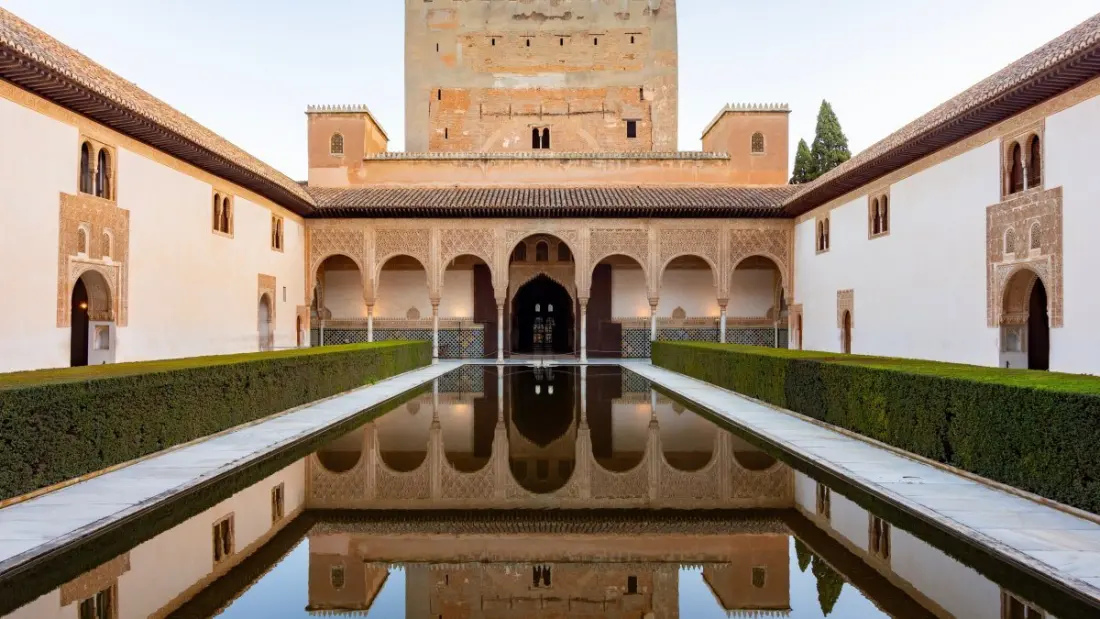
Spain's Alhambra in Granada appears as a lesson in water: pools that double the sky, channels that pull the eye across courtyards, sunlight made rhythmic by reflection. The builders didn't invent water's qualities — they arranged the place so those qualities could do the work.
The essay also nods to moderns who learned from the natural world: textile artist Anni Albers, who treated a thread's structure as a collaborator rather than an obstacle; engineer Frei Otto, who studied spider webs and honeycombs for his lightweight tensile structures; and Leonardo da Vinci, whose notebooks ranged across optics, anatomy and flight because seeing and understanding were, for him, the same act. Even the camera, the writer notes, imitates the eye — an instrument no human designed.
All of this leads to the closing thought: we build vast museums for what human hands made, but where is the museum of what we didn't? A feather, a nautilus spiral, a drop of water — the sky, sea and earth are the galleries, and the masterpieces never need restoration.
Why does this matter to a traveller? Because it changes how you walk through a site. Stand in the courtyard of the Alhambra or beneath a Sinan dome and you're not just sightseeing — you're reading a language of proportion, light and pattern that was there before anyone named it. The best travel habit this essay teaches is simple: slow down and look long enough. A pattern reveals order, order reveals harmony, and harmony turns a checkbox monument into something closer to wonder.
It's a philosophical read rather than a guidebook, but as motivation to book the flight to Istanbul or Granada, it does the job.
Daily Sabah Travel