Ever glanced at a flight attendant twelve hours into a long-haul and wondered how they're still standing? The answer is usually below or above your seat, behind an unmarked door. On the Airbus A380 — the largest passenger jet ever built — crew rest compartments are so spacious they effectively form a third deck.
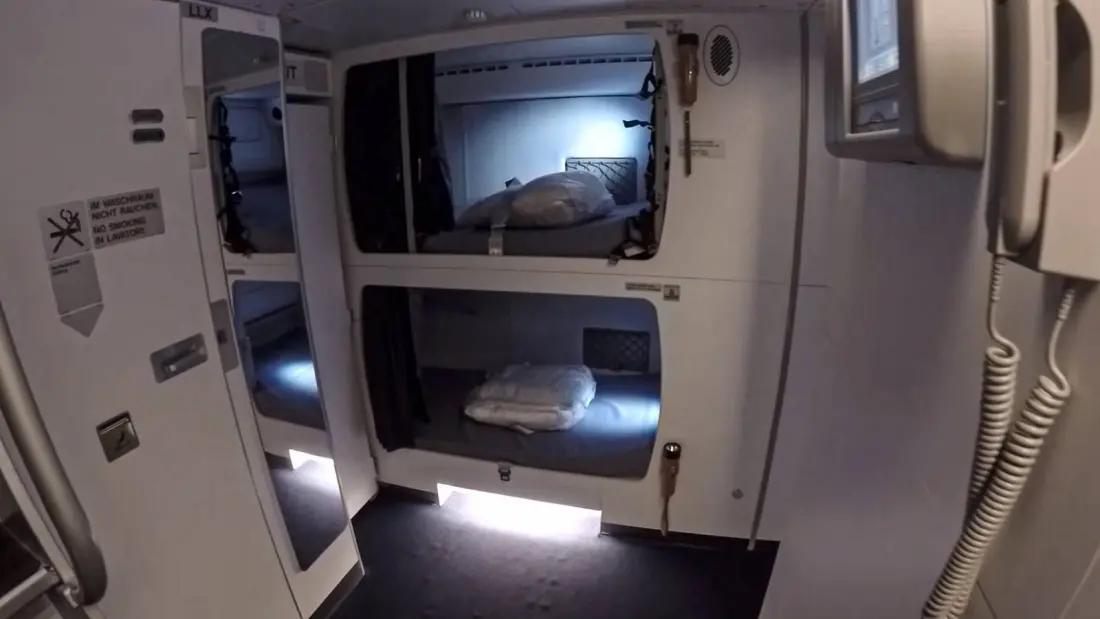
Airbus gives airlines several ways to configure A380 crew rest. A common setup puts a 12-bunk cabin crew compartment in the aft cargo hold on the lower deck, reached by a dedicated staircase from the main deck, so crew never walk through a passenger cabin to reach it. Alternatively, rest areas can sit on the upper deck — an Airbus training document from 2006 shows a version with 13 bunks. There's no single standard layout; each airline decides how to use the space.
Take Qantas, which flies ten A380s on routes like Sydney to Dallas/Fort Worth and Melbourne to Los Angeles — some stretching past 12 hours. Its A380s seat 485 passengers with roughly 20 crew rostered. The cabin crew rest area hides under the economy cabin behind a door near the mid-cabin lavatories that looks like an ordinary service panel; up to 12 crew can lie down at once, while pilots have their own berths near the cockpit. Emirates, the A380's biggest operator, mixes layouts: some aircraft have rest areas on the same deck as economy, others below it. The bunks are described as capsule-hotel style — each about the length of a full-size bed, with mattress, pillow, duvet, reading light, personal air vent and, on some aircraft, USB charging.
Other widebodies do the same thing in tighter quarters. On many Boeing 777s, including Cathay Pacific's 777-300ERs, a door disguised as a lavatory leads up to a compartment above the rear of economy with eight bunks in two rows of four. The Boeing 787 and Airbus A350 both tuck pilot rest behind the cockpit and cabin crew rest at the rear — the A350 has two berths up front and six at the back. Keen-eyed passengers can sometimes spot these zones: Qatar Airways' A350-900 has solid panels where overhead bins would normally be above the last few economy rows.
These aren't casual nap pods. Regulators treat rest compartments as certified parts of the aircraft. EASA rules for the A380 ban occupancy during taxi, takeoff and landing, cap occupancy at the number of approved berths, and require emergency lighting, fire equipment, two-way communication with the flight deck and two separate evacuation routes. The FAA sorts crew rest into three classes: Class 1 is a proper bunk space in the upper or lower fuselage, Class 2 a curtained lie-flat seat, Class 3 just a curtained recliner — and the A380 is roomy enough for airlines to use the best of them.
For travellers, it's a nice bit of context on ultra-long-haul flying: rest breaks of roughly 1.5 to 3 hours per crew member are built into the schedule, and the quietest corners of the plane — engineered away from noise, vibration and odours — are reserved for the people keeping you safe. Next time you board an A380, look for the door that doesn't quite make sense. That's where the crew goes.
Simple Flying