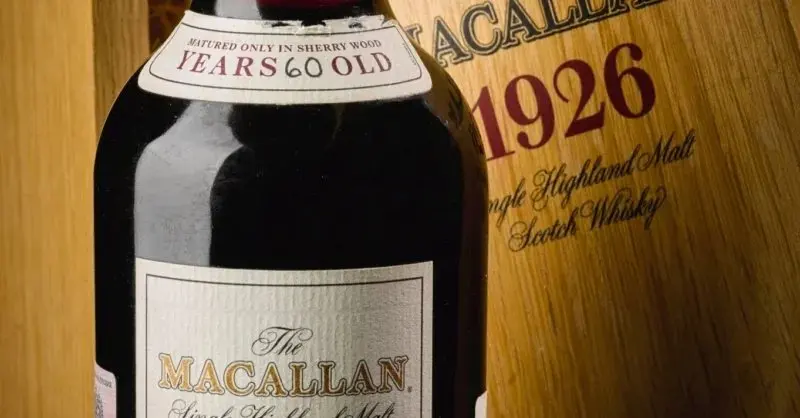
On October 9, Sotheby's stages its first-ever auction at a working distillery: Live from The Macallan Estate, held on the grounds in Speyside, Scotland. The headline lot is a bottle of The Macallan Fine & Rare 60 Year Old 1926, estimated at £1.7m to £2.2m ($2.3m to $3m) — right at the world auction record for whisky, set by another 1926 (the Valerio Adami edition) at £2.2m in London in 2023.
The backstory makes it easy to see why collectors care. Only 40 bottles of the 1926 exist. The spirit was distilled in 1926 and left to mature for sixty years in a single sherry-seasoned oak cask, No. 263, before being bottled in 1986 — at the time, the oldest Scotch ever bottled. The 40 were split across editions: 12 with labels by Sir Peter Blake, 12 by Italian artist Valerio Adami, up to 14 under the distillery's own Fine & Rare label, and two unlabelled, one of which was later hand-painted by Irish artist Michael Dillon.
This sale is the Fine & Rare edition — the least flashy of the lot, and arguably the least coveted. Alex Martin, editor-in-chief of World of Fine Spirits, calls it the distillery's standard design compared to the artist-label bottles that are "works of art." Sotheby's global head of whisky, Jonny Fowle, disagrees, describing it as the "purest expression of the 1926 story" and the cornerstone of the Fine & Rare Collection. Either way, at this level the label matters less than the mythology: each new record resets expectations for what the next bottle fetches.
Fowle's checklist for bottles of this calibre is rarity, provenance, condition and significance — with significance, the cultural weight, the hardest to quantify but increasingly decisive. He notes this is the first 1926 to hit the block since the record Adami sale, and the timing lands on the vintage's centenary, which is hard for collectors to ignore.
Holding the sale at the estate itself is a calculated move. Beyond the symbolism of selling the whisky where its story began, Martin thinks it widens the bidder pool: heavy press coverage should pull in every serious whisky collector plus generalist collectors from outside the whisky world entirely. The 1926 has become a name-brand collectible in its own right — the kind of object people buy without any intention of pouring a dram. And against the wider collectibles market, where a single Pokémon card fetched roughly $16.5m in February, a $2.7m bottle starts to look almost reasonable. As Martin puts it, it only takes two deep-pocketed bidders for the price to leap to another level.
For travellers, it's a reminder that Speyside has become a genuine pilgrimage route — a place where whisky heritage is now theatre as much as drink, and where the Macallan Estate sits among dozens of distilleries worth a detour. Even if you'll never bid, the story of what happens to a century-old cask is part of the region's pull.
Original reporting: Elite Traveler