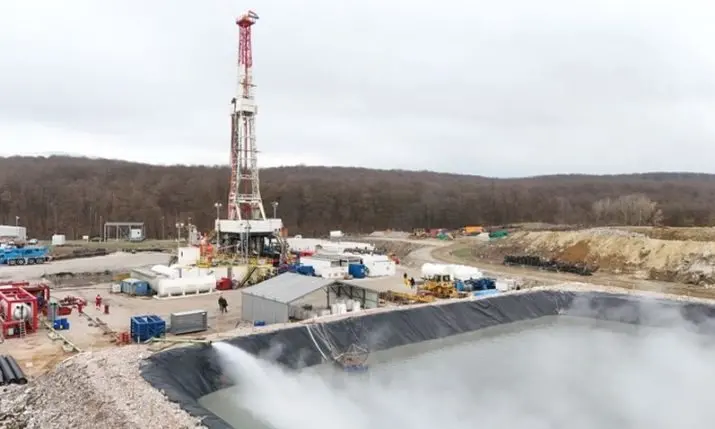
Croatia sits on more than sun and Adriatic coastline — several of its inland cities rest above serious geothermal heat, and the country is now moving to tap it on a bigger scale. The Agency for Hydrocarbons (AZU) has kicked off preparations for four new exploratory deep wells in Velika Gorica, Osijek, Vinkovci and Zaprešić, all aimed at replacing fossil fuels in urban district heating with locally sourced renewable heat.
The project is valued at around €35.15 million excluding VAT and is being funded through the European Regional Development Fund. Drilling will follow a turnkey model covering design, procurement and construction, with work expected to start in early 2027 once procurement wraps up. The whole build should take roughly two years and four months, with wells reaching depths of 2,000 to 2,300 metres.
The idea behind the engineering is a closed loop: hot geothermal water is pumped up for heating, then injected back underground to keep pressure and temperature stable in the reservoir. The four sites have already shown real promise. Velika Gorica and Osijek both have confirmed reservoir temperatures above 100°C, and in Velika Gorica the resource could eventually cover close to 60% of the city's district heating demand. Vinkovci recorded a striking 131°C at 2,700 metres in its GT-1 well, while Zaprešić's existing well flows at about 37 litres per second with a bottom-hole temperature of 95°C — possibly enough to heat the entire town on its own.
For travellers, this is the kind of quiet infrastructure story that shapes how a destination feels over the next decade. Croatia welcomes millions of visitors a year, many of whom pass through or stay in Zagreb's satellite towns like Velika Gorica and Zaprešić, both close to the capital and its airport. Cleaner district heating means lower emissions and more stable energy costs in the inland cities that usually get far less attention than the coast. It also fits into a broader European push to make city breaks genuinely lower-carbon, rather than just marketed that way.
There's a subtle tourism angle here too. Croatia's geothermal pockets overlap with spa and wellness country — the Pannonian region in the country's northeast has long marketed itself on thermal waters. If these wells prove commercial-grade, expect more towns to combine renewable heat with wellness offerings in the years ahead. The project won't change your 2026 holiday, but by the late 2020s the warm water in a Slavonian radiator may well be coming straight from the ground beneath the street.
Worth watching if you care about where your destination's energy comes from — and a good reminder that some of Croatia's most interesting heat isn't in the summer sun at all.
Story via Croatia Week.