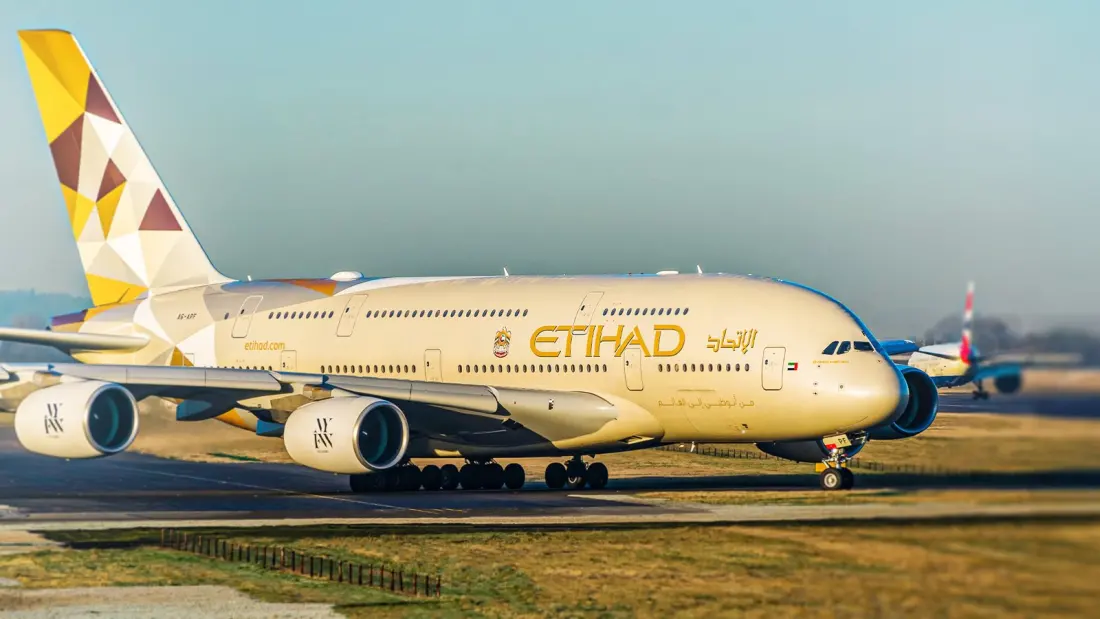
Abu Dhabi's flag carrier has finished bringing its entire Airbus A380 fleet back to life. Etihad parked all ten of its double-deckers when the pandemic hit in 2020, but the last stored jet, registered A6-APB, flew out of Tarbes-Lourdes in the French Pyrenees on September 17, completing the revival of all nine surviving superjumbos. The tenth airframe, A6-APA, is being dismantled and harvested for spare parts.
The reactivation was neither cheap nor quick. Each aircraft needed heavy structural checks, Engine Alliance GP7200 engine overhauls and full cabin recertification after years in storage, with costs running into the tens of millions per jet. Etihad started cautiously in July 2023 with four aircraft on Abu Dhabi-London Heathrow, then accelerated as delivery delays to the Boeing 777X and Airbus A350-1000 left it short of long-haul seats just as passenger volumes through Abu Dhabi hit record levels.
The logic is simple: at slot-capped hubs like Heathrow, an airline can't just add more flights, so it has to fly bigger planes. Each A380 packs 486 seats - over 40% more capacity than a modern twin-engine widebody on the same departure slot. Eight jets now fly continuous rotations while the ninth sits at Abu Dhabi as a maintenance reserve.
Travellers can currently catch the superjumbos on five routes: London Heathrow (up to three daily), Paris Charles de Gaulle, Singapore Changi, Tokyo Narita and Toronto Pearson - the latter a monster 5,900-nautical-mile leg pushing 14 hours. Aviation spotters can track individual airframes by entering their registrations, A6-APB through A6-APJ, into any live flight tracker.
For passengers, the real draw is the cabin. Up top sits The Residence, a three-room private suite with its own living room, bedroom and ensuite shower, plus nine First Apartments and 70 Business Studios above a dense 405-seat economy deck. A single round-trip Residence booking on the London-Abu Dhabi run can pull in over $50,000 in premium revenue, which is what makes four-engine fuel burn viable.
Don't assume this signals a broader A380 comeback. Etihad itself frames the jets as a bridge until delayed 777-9s and A350-1000s arrive, so the superjumbo's second act in Abu Dhabi has a shelf life. If you've always wanted to fly the upper deck of the world's biggest passenger plane on a top-tier carrier, the window to book it is now.