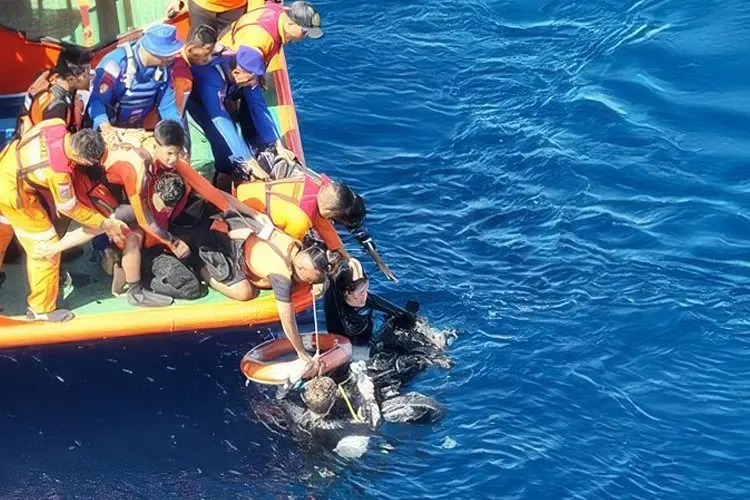
Four divers are safe after a strong current carried them kilometres out to sea during a dive off Flores, Indonesia, prompting an overnight search involving the navy, police and local fishing boats.
The group had been diving near Pulau Pangabatang, an outer island in the Maumere Sea Gardens in Sikka Regency, East Nusa Tenggara, on Sunday 4 October. Conditions were familiar territory for dive travellers: sloping coral reefs and walls, but also notorious currents, especially in the channel between the island and the Flores mainland.
The tourists were diving in two pairs, each with a local guide. The first pair — 60-year-old Dutch diver Bart Hazes and his 25-year-old guide Maria Rosa Hariana Djaa — surfaced as planned. The second team, made up of 42-year-old Austrian Patricia Retter, Irish divers Dervla Mulligan, 28, and Darragh McKiernan, 27, and 39-year-old guide Frederik Horimpun, never surfaced at the agreed point. The alarm went out around 2.10pm to the Maumere Search and Rescue Office (Basarnas), which coordinated a response with the Indonesian Navy, water police and local fishermen.
Retter was the first found, pulled from the water between Pulau Babi and Nangahale, roughly 5km from the dive site, at about 4.30pm. She was taken to Nangahale for medical checks. The search pushed on through the night, even deploying a thermal-imaging drone, and resumed at dawn on Monday. Around 9am, rescuers located Mulligan and McKiernan floating 5.9km from where the group had vanished — still kitted out in their scuba gear, which had kept them buoyant. Basarnas Maumere head Fathur Rahman said both were healthy but exhausted. Minutes later, a police vessel found their guide Horimpun alive 7.8km out. By Monday morning the operation was formally closed, with no reports of serious injury.
It is a genuinely lucky outcome, and a useful reminder for anyone booking dive trips in Indonesia. Sites around Flores and the wider Lesser Sunda islands sit between the Pacific and Indian Oceans, and currents there can shift fast and hard. That same water movement brings the manta rays and big pelagics divers travel for, but it demands honest self-assessment: check that your certification and experience match the site, listen to briefings, carry a surface marker buoy and signalling device, and confirm your operator's safety record and emergency procedures.
It is also worth noting what went right. The tourists were diving with local guides in small teams, the alert was raised quickly, and a coordinated rescue network of agencies and fishing communities swung into action. Those are exactly the things to ask about before you book with any dive centre in a current-prone region.
For travellers drawn to Flores, the Maumere area offers a quieter, less crowded alternative to better-known Komodo, with healthy reefs, accessible outer-island dive sites and a genuinely dramatic maritime environment — best explored with a clear head about its conditions.
Dive Magazine