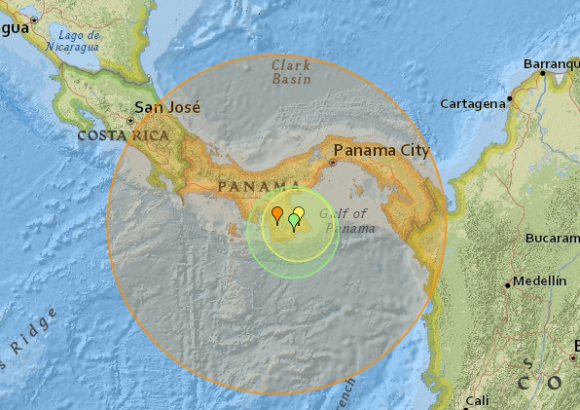
A magnitude 7.6 earthquake rattled southern Panama on Friday, sending people in Panama City pouring out of office towers and triggering a precautionary tsunami alert that stretched along much of the eastern Pacific coastline.
The USGS located the quake at 12:56 p.m. local time, striking at a shallow depth of 10 kilometres. The epicentre sat roughly 10 kilometres southwest of Pitaloza Arriba, a remote spot about 239 kilometres from the capital — which helps explain why Panama City's high-rises escaped serious harm even though the shaking was clearly felt there. Panama's civil protection agency said the damage was concentrated in the central provinces of Veraguas, Herrera and Los Santos, and officials were still assessing impacts while aftershocks continued.
The bigger scare came from the sea. The Pacific Tsunami Warning Center warned that hazardous waves could reach coastal areas of Panama, Colombia, Costa Rica, Ecuador, Peru, Nicaragua, Guatemala, El Salvador and Mexico within three hours, leaving national authorities to decide on evacuations for their own shores. Tsunami alerts after quakes of this size are often stood down quickly once wave readings come in, but coastal communities were told to stay clear of beaches and low-lying areas until given the all-clear.
For travellers, the practical takeaway is to know where to look when something like this happens. The USGS and the Pacific Tsunami Warning Center are the fastest, most reliable sources of verified information — far better than social media rumours. If you're staying on a Pacific beach in any of the countries listed, a long, strong shake is your natural warning to move inland or uphill immediately, without waiting for an official alert.
Panama itself remains a well-trodden, generally safe stop on Central American itineraries, and quakes of this kind are part of life in a country that sits on the boundary of several tectonic plates. Hotels in the capital typically have evacuation procedures, so note the assembly points when you check in. If you have trips planned to the Azuero Peninsula region near the epicentre — popular for its beaches and carnival season — it's worth checking road conditions and local advisories before travelling there while assessments continue.
The story was first reported by Dominican Today.