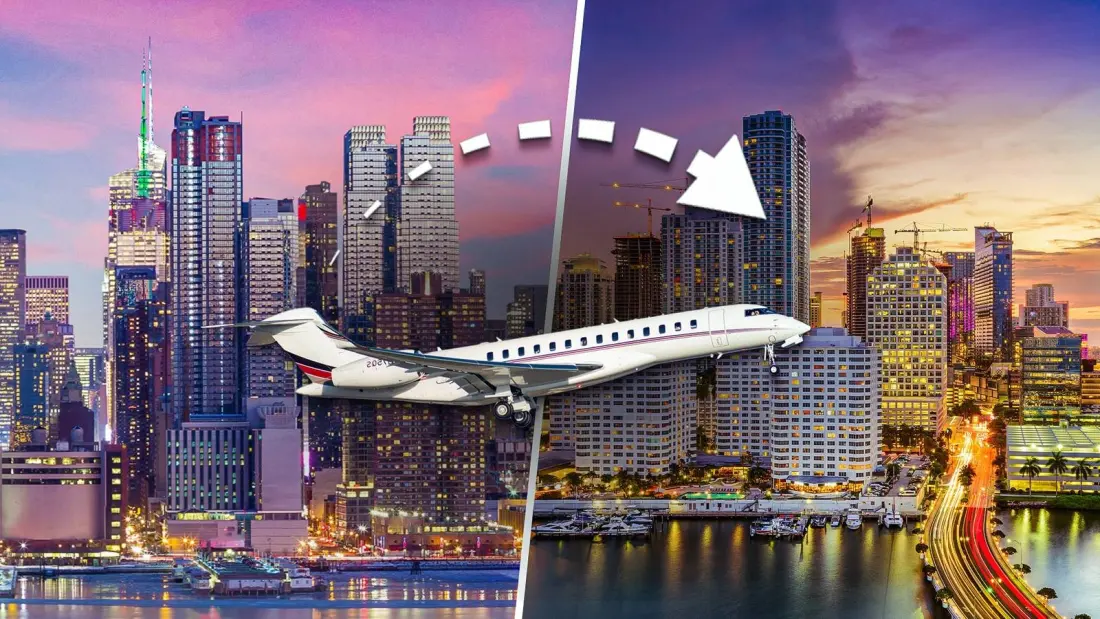
The New York–Miami corridor is private aviation's busiest playground: finance executives, snowbirds and seasonal residents shuttle down a 1,090-mile, 2.5–3 hour route so often that brokers use it as the benchmark for US charter pricing. The catch is that quotes swing wildly depending on what you fly, when you book and even which airport you leave from.
Aircraft size is the biggest driver. Light jets like the Cessna Citation CJ series or Embraer Phenom 300 run roughly $12,000–$24,000 one-way — the sweet spot for small teams and families who care more about skipping security lines than standing cabins. Step up to super-midsize and heavy jets such as the Bombardier Challenger or Gulfstream G450 class and you're looking at $35,000–$60,000 or more, with a flight attendant, premium catering and far more room included in the jump.
The short flight time hides real operational complexity. Landing fees, ramp handling, winter de-icing, overnight crew hotels and congestion surcharges all pile onto a base hourly rate that starts around $6,000. And in New York, private flights don't use JFK or LaGuardia — most depart from Teterboro (TEB) in New Jersey, plus Westchester (HPN), Morristown (MMU) and Republic (FRG) on Long Island. On the Florida side, Miami-Opa Locka (OPF) and Fort Lauderdale Executive (FXE) get you to Miami Beach or Palm Beach faster than Miami International ever will.
There are two ways to pay less. First, empty legs: repositioning flights sold at 25–75% discounts, sometimes under $10,000 on this route, because jets constantly reposition south for winter and back north afterward. The trade-off is fixed departure windows and little notice — you may need to commit within hours. Second, timing: December through March is peak 'winter migration', pushing rates up 20–40%, with extra spikes around Art Basel Miami Beach, the Miami Grand Prix and the Miami Open. Booking early, choosing off-peak slots and flying from a quieter airport all shave real money off the invoice.
For anyone tempted by ownership, the numbers get absurd fast: $3–8 million for a used midsize jet, annual fixed costs that can top $1 million, and a fuel burn of 150–300 gallons per hour. That's why most regulars stick to charter, jet cards or fractional schemes from NetJets, Flexjet and VistaJet — you pay per flight, not per hangar.
Even at the entry level this is a five-figure indulgence, not a budget hack. But if you're splitting the cost among seven people, racing to a Miami event or simply valuing three saved hours over $15,000, this corridor is the most transparent place in private aviation to do the maths. Flexible travellers willing to gamble on empty legs can occasionally get surprisingly close to first-class money for a genuinely private flight.