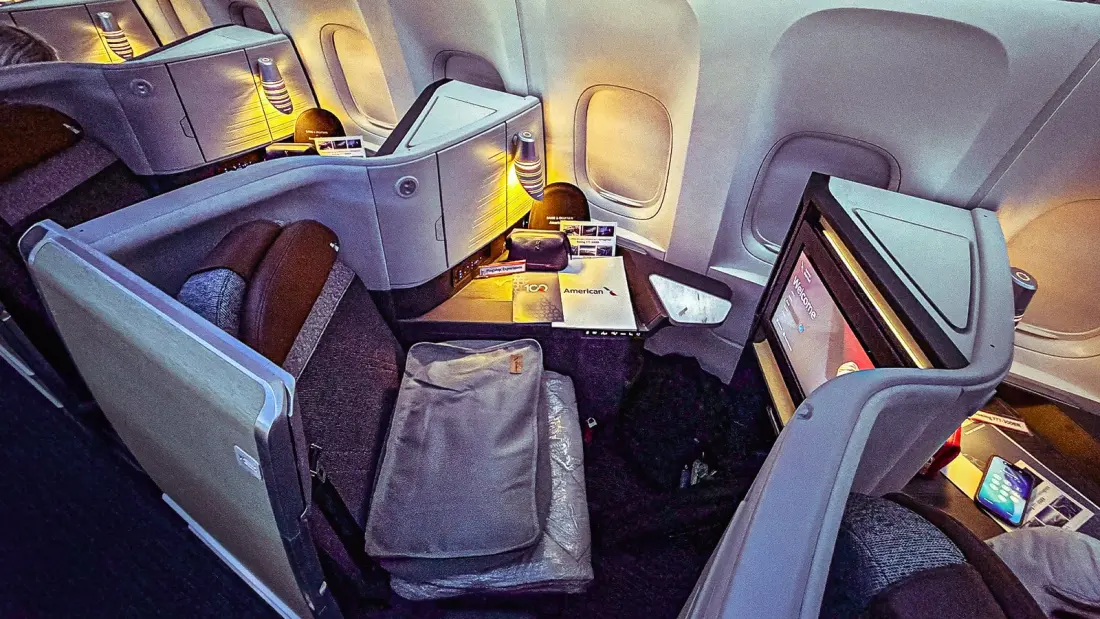
American Airlines has retired first class from its largest aircraft. A retrofitted Boeing 777-300ER flew its inaugural New York to Buenos Aires route on September 2 with no first class cabin at all — just 70 business class suites, 44 premium economy seats and 30 extra-legroom economy spots. Flagship First, the airline's legacy international first class product, stops being sold for travel from November 19, making American the last of the big three US carriers to drop a separate long-haul first cabin.
The maths explains the decision. The old 777-300ER carried just eight first class pods, 52 business seats, 28 premium economy seats and 216 in economy — 304 passengers in total. The new layout fits 330 people on the same airframe: eight first seats became 18 extra business suites and 16 extra premium economy recliners, with only two standard economy seats sacrificed. Premium seats of one kind or another now make up 44% of the cabin, which American says is the largest premium configuration of any US widebody. The rollout is slow, though — all 20 retrofitted jets are expected to be done sometime in 2027.
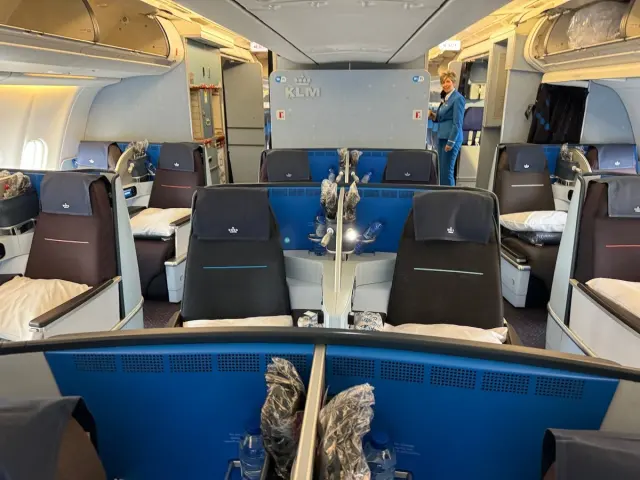
The business suites doing the replacing, branded Flagship Suites, come with sliding doors, direct aisle access, extra storage and a chaise lounge position. On the ground, business passengers get fast-track check-in, security, boarding and baggage, plus access to Flagship Dining. American first introduced these suites in 2025 on a premium-heavy 787-9 (51 suites) and the Airbus A321XLR (20), with the 777 borrowing elements from both. Delta pioneered business class doors back in 2017.
Why abandon first entirely? The numbers were brutal. Long-haul first cabins regularly filled as few as 20% of seats on some routes, well below the 80-85% airlines need for healthy profitability, and each pod hogged a huge chunk of floor space. Meanwhile premium customers — roughly 30% of passengers — generated nearly half of American's ticketed revenue in the second quarter, and premium unit revenue grew more than 13% year over year. United dropped international first class back in 2018; Delta folded its first cabin into business way back in 1998.
For travellers, the practical upshot: if you liked splashing out on Flagship First across the Atlantic or Pacific, that option is gone for good. The consolation is that business class is getting genuinely better — more suites, more privacy, and expanded dining access. Expect lie-flat seating across American's international fleet to grow by more than 50% by the end of the decade. The catch at the other end of the plane is that standard economy is the loser in the reshuffle, and seats that physically remain first class on un-retrofitted jets will simply be sold as business until the conversion finishes.
The 777-300ERs serve London, Tokyo, São Paulo, Buenos Aires and Sydney, so this affects some of the world's busiest premium routes. Whether all 70 suites fill consistently on every route is the open question — but for now, the era of US international first class is officially over.