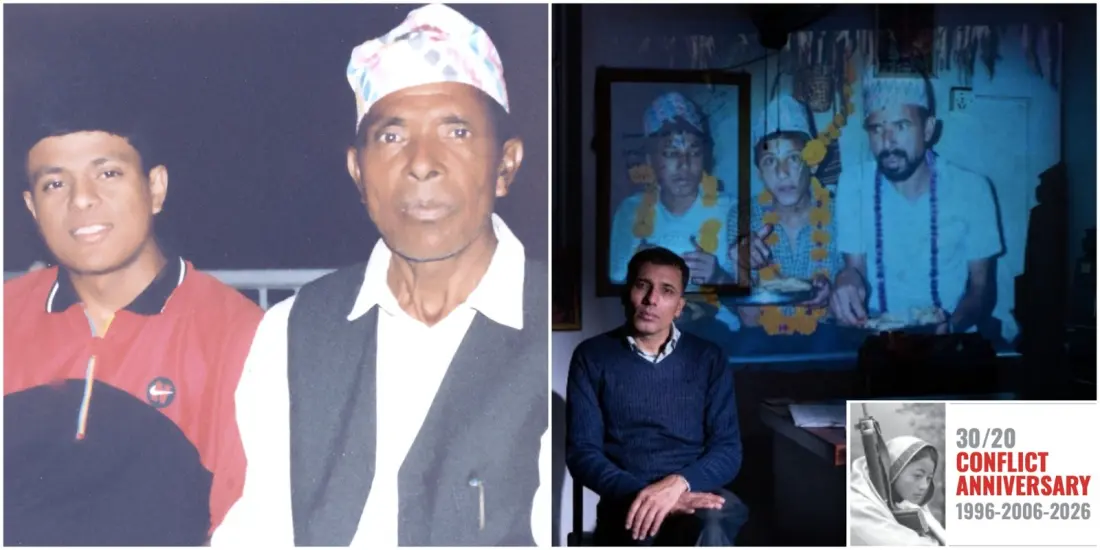
Ram Bhandari and Suman Adhikari grew up in the same district of Lamjung, in central Nepal. Both lost their fathers during the country's civil war — but to opposite sides. Today the two men are human rights activists who have spent decades demanding what Nepal has never delivered: an honest accounting of a conflict that killed around 17,000 people and left 1,400 still officially missing.
Bhandari's father, Tej Bahadur, a teacher and well-loved local figure, was taken by state security forces in Besisahar in December 2001, accused of being a Maoist. Witnesses saw him blindfolded and beaten before being driven away. His family never learned where he went or where he might be buried. Adhikari's father, Muktinath, a science teacher, was dragged from his classroom by Maoist rebels in January 2002, tied to a tree and shot for refusing to back the revolution and for teaching Sanskrit.
Why does this matter to visitors? Because the war is strikingly invisible in Nepal. It ended with the 2006 peace accord, the former rebels became part of the state, and yet history textbooks skip the conflict entirely. The Truth and Reconciliation Commission and the disappearances commission, set up after a 2014 law and amended only a decade later, have produced no convictions — activists say the commissions were politicised by the very people who should have been held to account. Both men are now placing cautious hope in the new RSP government, which has dismantled the old commissions and could restart the process with genuine victim participation.
For travellers trekking through Lamjung, the gateway to the Annapurna region, or walking through towns like Besisahar, this story is a reminder that the friendly villages on the trail carry recent, unspoken grief. Neither side of the conflict spared civilians — teachers, farmers and families bore the heaviest toll. Adhikari also points to the GenZ protests of last year, where young protesters were killed by security forces, as proof that impunity is still a live issue in Nepal, not a historical footnote.
Neither man is looking for revenge. They want the state to formally acknowledge what happened, offer reparations covering psychological, social and financial support, and build a transparent commission with victims at the table. 'As long as I am alive, I will keep seeking the truth,' Bhandari says. For anyone visiting Nepal and wanting to understand it beyond the mountains and temples, the unresolved legacy of the conflict — and the quiet persistence of people like these two sons — is part of the real country you are travelling through.