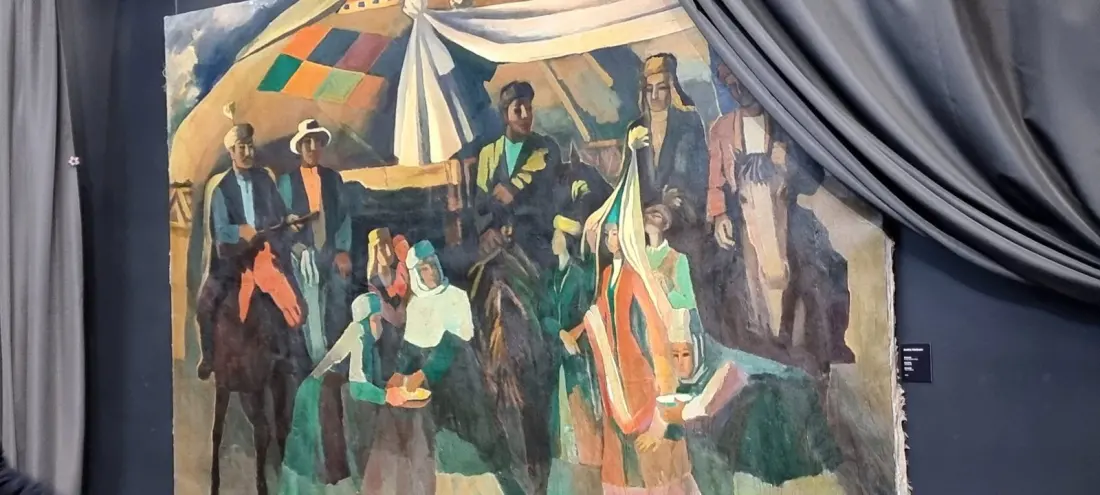
An exhibition built around a single wedding ritual has opened in Astana. From 8 October, the works of Kazakh artist Issatay Issabayev go on show with one theme throughout: betashar, the traditional ceremony in which a bride's covered face is unveiled as she is formally introduced to her groom's family. The show is part of a wider run of events marking the 90th anniversary of the artist's birth.
Curator Saltanat Sabyr says this exhibition breaks from previous retrospectives because everything hangs on one work and one idea. That is an unusual framing for an artist best known as a graphic artist and illustrator. Here, he is presented as something closer to an ethnographer — someone who analysed Kazakh nomadic culture rather than simply decorating someone else's folklore.
The exhibition traces a decades-long obsession. According to the artist's daughter, Aliya Tulenova, wedding scenes ran through his career from the mid-1960s: a 1967 work dedicated to writer Mukhtar Auezov includes a scene from the wedding of Abai, the great Kazakh poet; a 1968 piece on the hero Kambar Batyr carries the same theme; in 1973, while designing a cinema in Semey, he sketched a bride among other figures. The anchor of the current show is a large canvas from 2002 — two by three metres — devoted entirely to betashar. He kept working on the subject until the end of his life.
Tulenova explains the logic: in Kazakh epic poetry, a hero's marriage is a fixed milestone, alongside his birth and his deeds. Since epics were Issabayev's core source material, weddings kept surfacing in his work.
For visitors unfamiliar with the ritual itself, the exhibition doubles as a cultural primer. Betashar unfolds with the bride's face covered, which in Kazakh tradition carries associations with death. Lifting the covering therefore reads as a symbolic ending of her old life and a rebirth into her husband's family, marked with blessings. A singer or dombyra player then names the groom's relatives one by one, helping the bride learn who is who. In 2024, UNESCO added betashar to its Representative List of the Intangible Cultural Heritage of Humanity — worth knowing before you go, since it puts the paintings in context.
Why does this matter to a traveller? Because it is a rare chance to see a living tradition explained through the eyes of an artist who spent 40 years on it, in the capital where much of the country's cultural programming happens. If you are visiting Kazakhstan and want more than landscapes and food, a couple of hours here will teach you more about Kazakh family life than most guidebooks. It is also a good lead-in to catching a real betashar at a wedding — locals may well invite respectful visitors if the occasion arises.