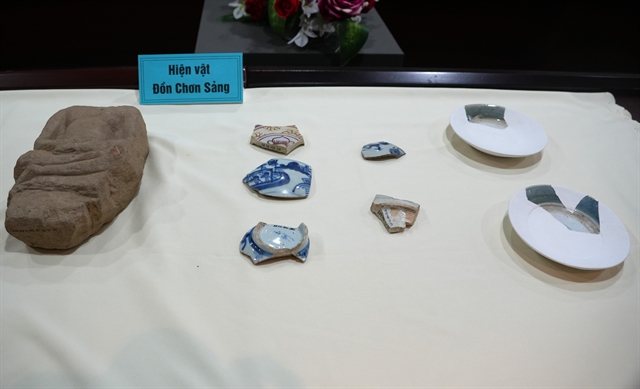
A fresh batch of history has landed at the Da Nang Museum: 88 artefacts — ceramics, terracotta and stone pieces — recovered from two excavation sites at the foot of the Hai Van Pass, the dramatic coastal pass that separates Da Nang from Hue.
The digs ran from May to August at Chon Sang Garrison and Nam Chon Station, two former defensive posts on the old Thien Ly route, Vietnam's historic north-south artery. A joint team from the Da Nang Management Board of Monuments and Landscapes and the Institute of Archaeology spent 45 days on site, uncovering outer ramparts, stone walls, dikes, defensive ditches, stone-reinforced terraces and building foundations — plus 964 artefacts in total.
The story the finds tell goes back further than expected. Among them was a sandstone statue and a sculpted relief bearing ancient Champa inscriptions, provisionally dated to the 8th century — centuries before the posts themselves were built. The military structures, meanwhile, date to the 19th century under the Nguyen Dynasty: both posts appear on a defence map drawn during King Tu Duc's reign (1847–1883), and French records list them as fort royal de Nam Kin and fort de Kien-Chang. Archaeologists think the evidence connects the sites to regional defence during the French-Spanish assault on Da Nang that began in 1858.
The hand-over at the museum is more than a paperwork exercise. The excavated material will feed into a dossier seeking formal recognition of the sites as archaeological relics — a step that could eventually make them visitable.
For travellers, this is a good excuse to look past the beach. The Hai Van Pass area is already a favourite drive for motorbikers and road-trippers between Hue and Da Nang, and the excavation sites sit close to the Hai Van Gate, a brick fortification complex built around 1826 under King Minh Mang. The posts were part of a wider defensive web that included the Dien Hai Citadel — now a National Special Relic — and the An Hai fortress, which together guarded the strategic seaport on the Han River in the era of King Gia Long.
In other words, one of Vietnam's most scenic stretches of road is slowly revealing itself as a layered military history site: Cham-era carvings, Nguyen-era walls and colonial-era conflict, all within a few kilometres. Whether the new dossier leads to an open-air site or museum display remains to be seen, but anyone making the Hai Van crossing in the next few years may get to see this chapter of Da Nang's past up close. Keep an eye on the Da Nang Museum, where the collection is now stored and studied, for what comes next.