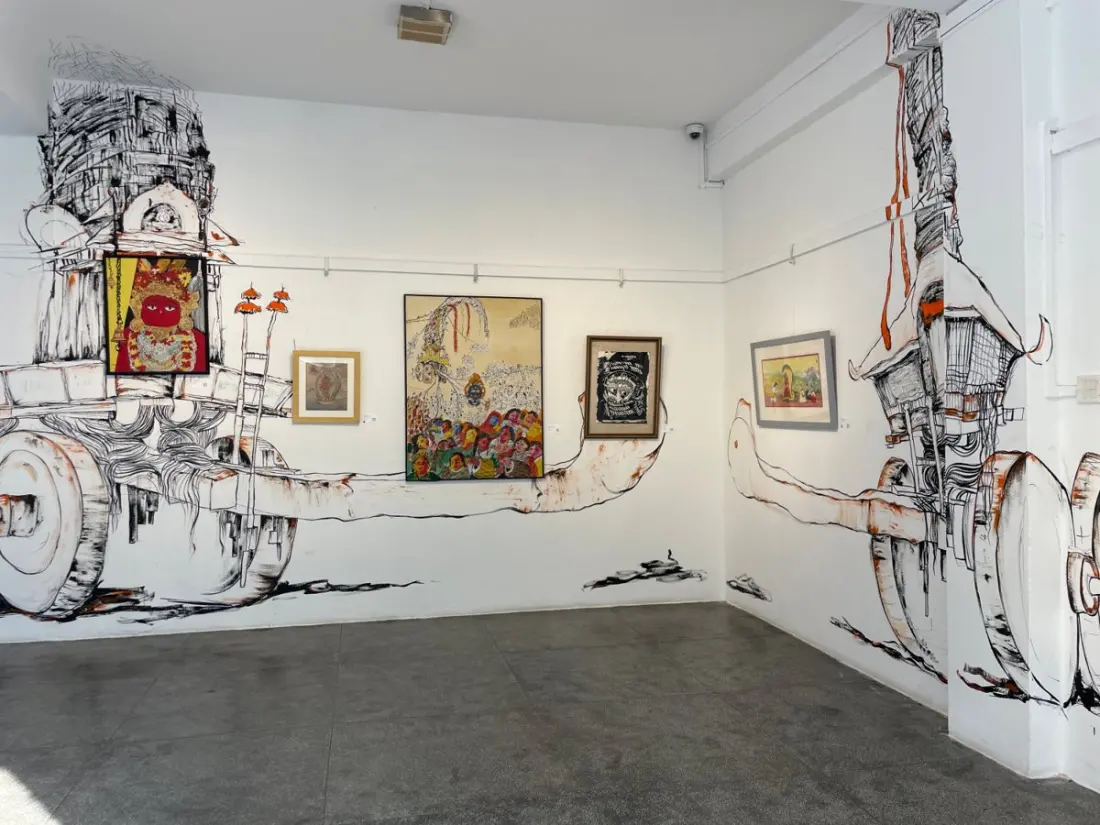
At the Nepal Art Council in Kathmandu, this autumn's Deities of Nepal III exhibition turned three floors of gallery space into something closer to a pilgrimage route. Running from 17 September to 10 October, the show gathered 285 works from 157 artists — established names and newcomers side by side — around the myths, rituals and legends that shape everyday life in Nepal.
The layout itself told a story. The first floor opened with Ganesh, the god invoked first in Hindu ritual, before widening into Shiva, Bhairab and the wider pantheon. Upstairs, the focus shifted to specific legends of the Kathmandu Valley and beyond. Kabir Kayastha's painting traced how Bunga Dyah, the valley's rain god, was brought to Kathmandu during a drought, while Sharda Chitrakar's acrylic of women pulling the deity's chariot doubled as commentary on women reclaiming male-dominated festivals — and, given the Chitrakar community's history of teaching art only to sons, on the artist's own career.
Other highlights leaned into Nepal's geographic and artistic diversity. Kalu Kumale's statue of Manjushri, sword raised, stood over projections of water recalling the valley's origin story as a drained lake. S C Suman brought Mithila art tradition into a vivid marriage scene of Sita and Ram, and Tenzin Norbu's Dolpo-based paintings about the saint Milarepa read like a graphic novel you could walk through. Co-curator Pranab Man Singh framed the whole idea as treating artists as custodians of lore rather than illustrators of fixed religious characters — a theme Yuvak Tuladhar ran with literally, embedding the Tara mantra in binary code.
For visitors, the most memorable part may have been the most low-tech: a DIY wood block printing corner where anyone could pull a print of Ganesh, Lakshmi, lotus or naga designs for Rs10. In an era of AI-generated images, pressing paper onto an inked block and watching the pigment bleed through felt like the point of the whole show.
Why should a traveller care? Because Deities of Nepal is exactly the kind of event that turns a Kathmandu stay from temple-ticking into genuine understanding. The exhibition ran guided tours with heritage scholars — genuinely worth joining, since the reviewer admits wandering lost until one put the stories in context — plus artist talks. Even if you missed this edition, the Nepal Art Council stages it regularly, and the city's gallery scene is an underrated rainy-season or pre-trek activity. It also explains what you'll see on the street: the chariots, the jatras, the gods who supposedly walk among Kathmandu's residents. Go for the art, leave knowing the stories behind the festivals you'll stumble into.