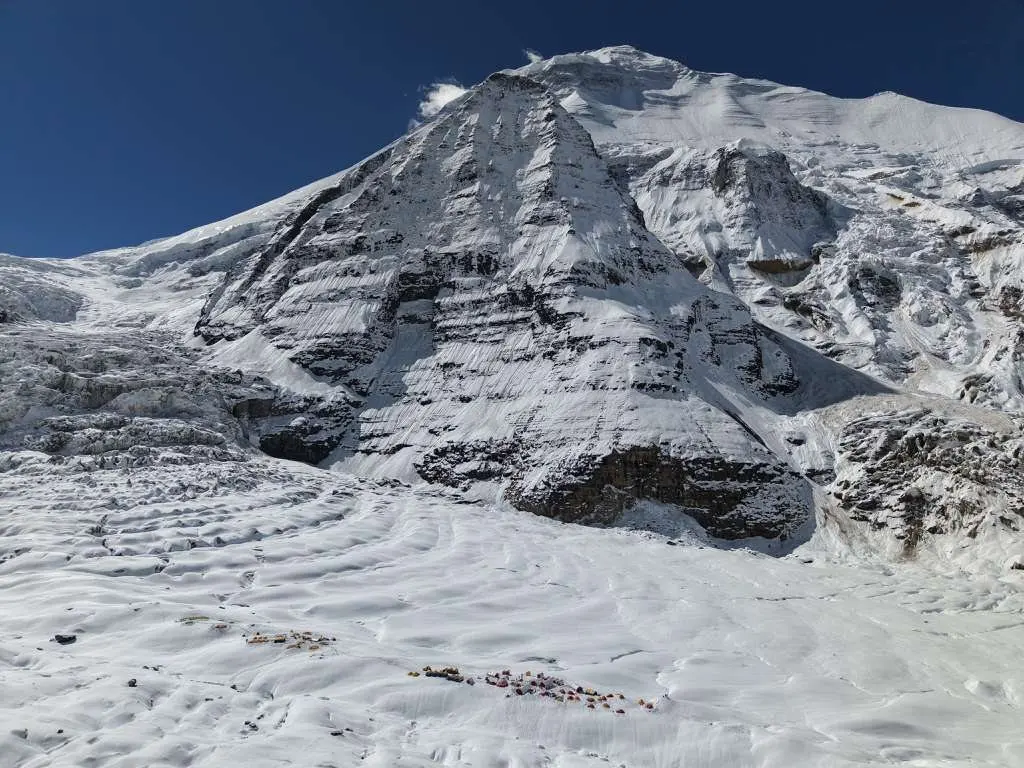
After days of shovelling snow, the mood at Dhaulagiri Base Camp has flipped. A late September storm scattered most teams, but stable weather has brought everyone back — and now climbers are streaming up the mountain toward Camp 3, at roughly 7,300-7,400m on the normal route.
Australian climber Paul Clarke, speaking from Base Camp, described the scene as transformed: helicopters ferrying climbers and Sherpas all day, and the camps of 14 Peaks Expeditions and Seven Summit Treks — Nepal's two biggest outfitters — looking like a small town again. Clarke is climbing with his partner Xenia Santha as part of the 8K Expeditions team, one of the few groups that stayed through the storm. Once reports from higher up came back positive, they set off to follow the rope-fixing crew.
Those fixers have been busy. They dug out ropes buried by the snowfall and fixed another 400m above Camp 2, with plans to push on to Camp 3. Their work sets the track everyone else will follow, since there is no broken trail higher up and conditions remain uncertain.
All eyes are on Polish ski mountaineer Andrzej Bargiel, who arrived on Friday with skis and ambitions. He skipped a slow acclimatisation by warming up on Manaslu first, where he reached 6,000m before relocating. After a night at the so-called Italian Camp at 3,600m — lower and comfier than standard base camp — he moved straight up and was expected at Camp 2, with Camp 3 to follow.
The big question is who turns Camp 3 into a summit push and who treats it as another rotation. Altipro Adventures has given its small team a clear deadline: on the summit before 15 October if conditions allow. Others, like 14 Peaks leader Makalu Lakpa, are still reading the mountain. Going straight up carries real risk — insufficient rest and acclimatisation before a brutally long summit day — but there's pressure to move fast. Outfitters increasingly run short expeditions, and the sooner Dhaulagiri is done, the sooner they can shift Sherpas and gear to Ama Dablam and other commercial 6,000m and 7,000m peaks.
One curiosity: when heavy snow wrecked plans on nearby Manaslu, some wondered if its roughly 500 permit-holders would simply relocate to Dhaulagiri. Apparently not. Nepal's Department of Tourism listed 36 foreign climbers on Dhaulagiri as of 1 October, barely up from 34 two weeks earlier. Some climbers, though, had booked Manaslu-Dhaulagiri double-header trips from the start, and they're among the new arrivals in camp. Counting Sherpas, somewhere around 70-80 people are on the mountain.
For travellers and armchair mountaineers, this is a rare live look at how an 8,167m peak gets climbed: weather windows, rope-fixing logistics, and the commercial rhythms that shape modern Himalayan expeditions. The next day or two at Camp 3 will tell the story.