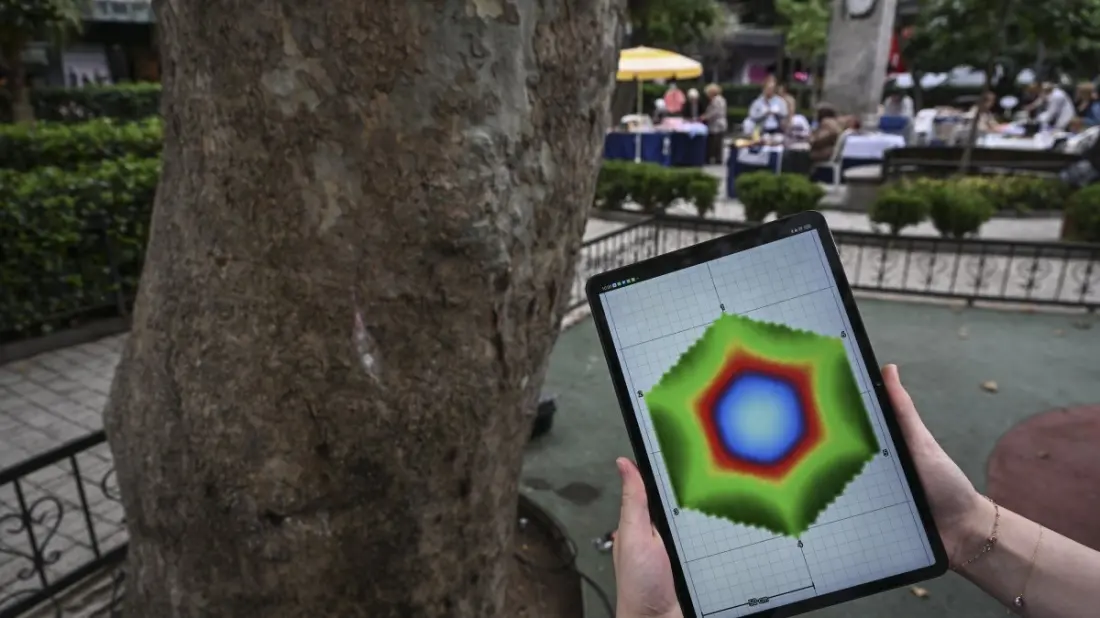
Istanbul's oldest trees are getting a health check that involves sound waves rather than saws. Researchers from Istanbul University-Cerrahpaşa's Faculty of Forestry are scanning around 200 large, mature trees across the city for internal decay, using a technique called acoustic tomography that can spot trouble long before a trunk shows any visible signs.
The method is simple in principle: sensors are attached at intervals around the trunk and send sound waves through the wood. Healthy tissue and rotten or hollow sections conduct sound at different speeds, so the measurements reveal cavities and decay hidden inside. If something suspicious turns up, the team repeats the scan at different heights to map how far the damage extends, then builds a 3D picture of the trunk's condition.
Crucially, a rotten core does not mean a chainsaw is on its way. The tomography data is combined with each tree's height, crown diameter, lean, branching pattern and exposure to wind — plus historical records of the strongest winds in the area — to calculate an actual falling risk. Trees deemed high or extreme risk get interventions first: crown-weight-reducing pruning, cavity cleaning and mechanical supports. Felling is a last resort, reserved for trees past saving. Researcher Serhun Sağlam put it plainly: if a tree can safely live another 10 or 20 years, the team will keep it in place.
The urgency is real. Last month a large plane tree came down in the Teşvikiye district that looked perfectly healthy from the outside — only after it fell did investigators find decay running from the roots up into the trunk. Teşvikiye, though a small district, holds a notable population of old trees: many plane trees there are over a century old, some 130 to 150 years, and a number are officially registered as monumental trees. The study also covers the veteran trees at Darülaceze, a charitable institution with more than 130 years of history.
For visitors, this is a quiet reminder that the shade you rest under in Istanbul's parks and busy pavements may be older than the buildings around it — and that the city is working to keep it that way. Urban trees, Sağlam notes, clean the air, ease flooding, cool summer streets and cut winter energy use. Travellers can do their part by not damaging roots, trunks or branches when picnicking or wandering. If you're strolling Nişantaşı or Teşvikiye, look for the plaques on registered monumental trees; some of those plane trees were saplings before the Republic existed. A tree that has survived 150 years of city life deserves a gentle hand rather than a carved initial.