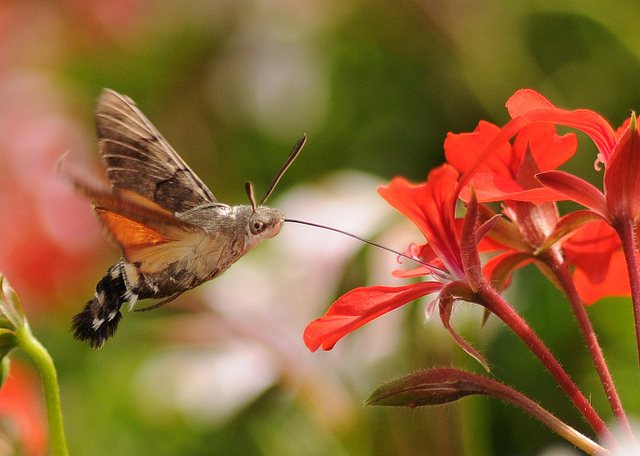
It hovers at flowers, hums as it goes, and at first glance you could easily mistake it for a tiny hummingbird. It is neither a bird nor even close to one — it is a moth. The hummingbird hawk moth is the star of a recent feature from The Ark in Space, republished via Kuriositas, which makes the case that this unassuming insect might be one of the coolest creatures on the planet.
What makes the moth so striking is a neat bit of biology called convergent evolution. That is the phenomenon where two completely unrelated species independently evolve the same solution to the same problem. Hummingbirds sip nectar while hovering, so they evolved rapid wingbeats and a long bill. The hummingbird hawk moth faced the same challenge — reaching nectar deep inside flowers while staying airborne — and arrived at a remarkably similar answer: fast-beating wings, a streamlined body and a long proboscis that uncoils like a drinking straw. The result is an insect that behaves, sounds and looks startlingly like a bird several thousand times heavier than itself.
The feature is worth a look mainly for the photography. Shot in close-up and full screen, the moth's fuzzy thorax, blurred wings and extended proboscis make the hummingbird resemblance obvious — and genuinely impressive. It is a reminder that some of the most spectacular wildlife encounters happen at a scale most travellers walk straight past.
Why should a holidaymaker care? Because this is one of the easiest wildlife spectacles to tick off. Unlike tracking snow leopards or nesting sea turtles, hummingbird hawk moths turn up in ordinary gardens, meadows and roadside verges on bright summer days, hovering over flowers such as honeysuckle, lavender and buddleia. If you are travelling in Europe or Asia between roughly late spring and early autumn, keep an eye on any sunny patch of flowers. If something small hovers in front of a bloom with an audible hum and darts off backwards, you have probably found one.
For families, photographers and anyone who enjoys low-effort nature spotting, it is an ideal addition to a walking holiday or a slow afternoon in a cottage garden. No guide, no permits, no patience-testing dawn starts — just a flowering shrub, a bit of sunshine and a willingness to stop and look. And if you fancy a shortcut to good pictures, the Kuriositas piece collects some of the best, ideal for knowing exactly what to look for before you head outdoors.