When engineers flooded a Panamanian valley to build the Panama Canal, an accident of geography created something remarkable: Barro Colorado Island, a 15-square-kilometre fragment of rainforest cut off from the mainland and rising out of Gatun Lake. Over the past century it has become one of the most intensively studied patches of tropical forest on Earth, precisely because its isolation shields it from much of the human interference that affects forests elsewhere.
That makes what scientists are seeing there especially troubling. Many of the island's giant trees — the towering, centuries-old canopy specimens that define old-growth tropical forest — appear to be dying prematurely. And Barro Colorado is not an outlier. The same pattern is showing up across the tropics, and researchers don't yet fully understand why.
The stakes go well beyond aesthetics. Big old trees are the forest's carbon vaults, storing enormous quantities of CO2 in their trunks and roots over long lifetimes. If they are dying off decades before they should, that stored carbon gets released back into the atmosphere — the opposite of what a warming planet needs. Old giants also anchor the ecosystem itself, providing hollows, food and structure that younger trees simply can't replace.
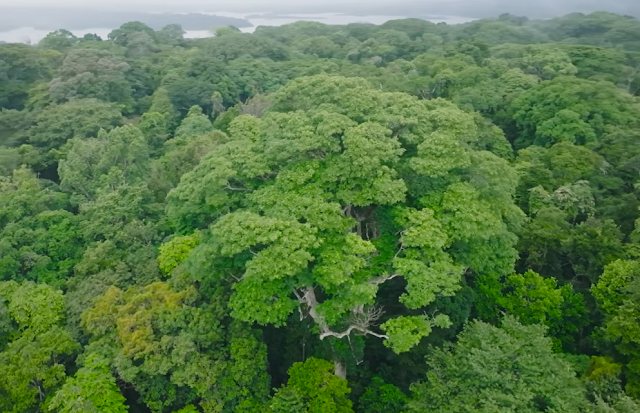
Amid the bad news, one species is bucking the trend. Dipteryx oleifera, a massive canopy tree found on Barro Colorado, isn't just surviving while its neighbours decline — it's thriving. Understanding why this one giant is flourishing, while others falter, could hold clues to what is stressing the rest of the forest, and perhaps point towards a way to protect it. A recent video explainer hosted by science communicator Joe Hanson uses striking drone footage to show the island's forest canopy from above and unpack the research for a general audience.
For travellers, Barro Colorado offers a rare chance to see frontline tropical science up close. The island is administered by the Smithsonian Tropical Research Institute, and guided day visits from Panama City take visitors into one of the world's great natural laboratories — where the fate of the giant trees, and by extension the carbon stored in tropical forests everywhere, is being worked out in real time. Even if you never set foot there, the story is worth knowing: it reframes the rainforest you see on any Panama trip not as a static postcard, but as a system under measurable, and surprising, change.