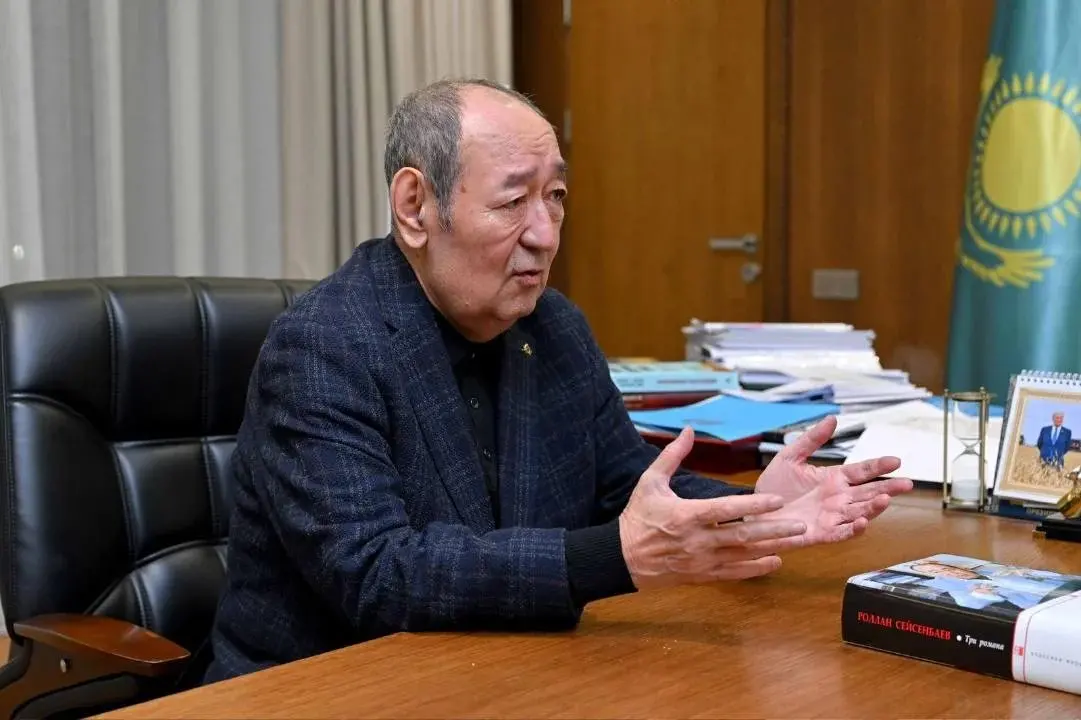
Kazakhstan is marking a literary milestone this October: Rollan Seisenbayev, one of the country's most widely read authors abroad, turns 80 on Oct. 11. Born in Semei in 1946, Seisenbayev spent decades carrying Kazakh stories to readers in the Soviet Union, Europe and beyond — and his work doubles as an unusually deep guide to the country's history and identity.
His breakthrough came during a long stint in Moscow, where he represented the Writers' Union of Kazakhstan from 1976 to 1991. Books like "The Last Snow" and "The Dead Wander In The Sands" introduced broad Soviet audiences to life in Kazakhstan, while "The Throne of Satan" was translated into several languages and found recognition in Europe. Along the way he collected an impressive pile of honours: the Antoine de Saint-Exupéry International Prize, the Jack London International Literary Prize, an award from Columbia University, and — all in 2006 — distinctions from Poland, Hungary and Cuba.
The book many consider his most important is "The Day The World Collapsed" (1988), about the Semipalatinsk nuclear test site near his hometown. It tells of the first hydrogen bomb test through the memories of villagers who lived through it, many of whom had no idea what had happened to their homes. With most witnesses of the testing era now gone, the book stands as rare first-hand testimony — and it has been translated into numerous languages.
Seisenbayev's other big project was exporting the legacy of Kazakh poet-philosopher Abai. He helped open Abai House in London in 1995, founded the International Abai Club and the Amanat magazine in 2001, and through those platforms published some 200 volumes of world classics. There's a lighter footnote, too: as a student he was a champion wrestler who earned the title of master of sport of the Soviet Union.
Why should travellers care? Because Kazakhstan's cultural scene can feel elusive to visitors, and Seisenbayev's books — rooted in the steppe, the nuclear legacy and Abai's wisdom — offer real context before a trip. His story also maps neatly onto actual places: Semei (now Semey) in the east, gateway to the Semipalatinsk test site history; Almaty, where he still lectures and meets students; and even a London cultural outpost tied to Abai. Readers drawn to literary travel will find his Kazakhstan far richer than the postcard version.