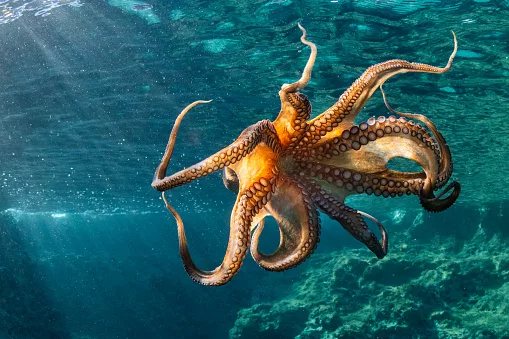
Every 8 October, marine lovers mark World Octopus Day — and for good reason. The octopus is arguably the strangest animal you can spot in a rock pool or on a dive: three hearts, a brain that extends into its arms, and skin that can change colour and even texture to vanish against coral or sand.
The biology is genuinely odd. Two of those hearts pump blood to the gills, while the third handles the rest of the body — and it stops beating when the octopus swims, which is why they'd rather crawl along the seabed than swim. Each of the eight arms carries its own neural network, processing touch, taste and smell semi-independently of the central brain. Lose an arm? It regrows, nerves and all, and some species keep using the others meanwhile.
Because they have no skeleton or shell, octopuses can squeeze through any gap their beak fits through — hence their reputation as underwater escape artists. They're also surprisingly short-lived: most live just one to two years, though one deep-sea mother was recorded guarding her eggs for a remarkable 53 months.
The day isn't only a celebration. Octopuses as a group aren't endangered, but warming waters, pollution and plastic ingestion are mounting threats, and overfishing — for food and the aquarium trade — adds pressure. Then there's the farming question. Plans for what would have been the world's first commercial octopus farm, in Spain's Canary Islands, were abandoned in July 2026 after years of opposition from welfare groups, scientists and the public, who argued that keeping such intelligent animals in intensive systems is cruel and that farming them requires wild-caught fish as feed, an environmental problem of its own.
For travellers, the takeaway is simple: the best way to appreciate an octopus is to see one in the wild or at a reputable aquarium or marine education centre, not on a plate from an intensive farm. Snorkel or dive responsibly, look closely at rock pools at low tide, and support coastal conservation outfits that teach visitors about ocean ecosystems. Anywhere from South Africa's kelp forests to Mediterranean reefs, you might just lock eyes with a creature watching you back through skin that's already matching your background.
Story via Getaway South Africa.