
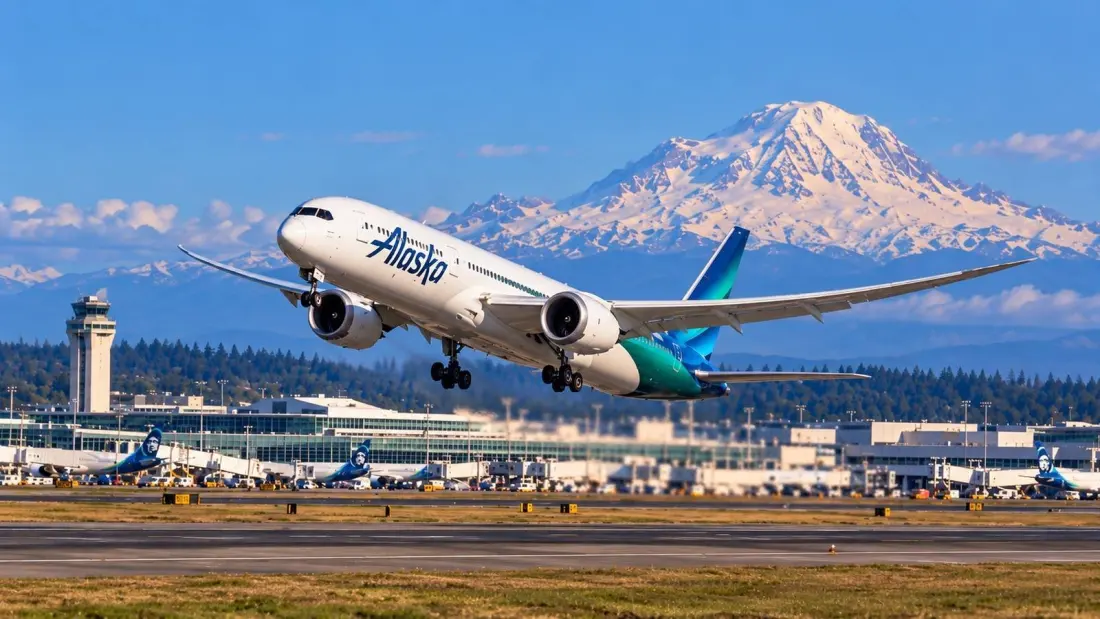
Seattle-Tacoma is Alaska Airlines' home turf. The carrier runs 303 daily nonstop departures from SEA and accounts for more than half of the airport's scheduled passenger activity. But not every route is packed. US DOT data for the 12 months to June 2026 shows the airline's Seattle flights averaged a healthy 83.2% full — yet eleven routes fell well below that, and one didn't even come close.
The standout laggard is Vail, Colorado, at just 36.7%. Alaska launched the winter-only ski route in December 2024 on 76-seat Embraer E175s, flying three times a week over the Christmas and New Year period. January 2026 was the low point: barely 20 of 76 seats filled. Even worse for the airline's accountants, the route had by far the weakest revenue per available seat mile of any Seattle route, roughly 20% below the next-lowest (Cincinnati). Fares averaged $258 one-way — decent money per passenger, but not when most of the plane is empty.
Other thin routes are mostly ski and resort destinations: Steamboat Springs (61.3%), Sun Valley (63.4%, despite a record number of flights), and Jackson Hole (65.1%). Arcata/Eureka, a California route launched in April 2026, came in at 72.3%.
Several short-hop routes like Walla Walla, Eugene and Redmond/Bend also made the list, but low loads there aren't necessarily a problem. These are high-frequency routes — Bozeman alone carried over 220,000 round-trip passengers — designed to feed connections through the Seattle hub rather than fill planes point-to-point. Plenty of those passengers are continuing elsewhere, so a 'half-empty' flight can still earn its keep.
The more interesting names for international travellers are Rome (66.8%) and London Heathrow (68.2%). Both are brand-new: Rome launched in April 2026, Heathrow in May with a daily widebody operation. Low initial load factors are normal for routes in their first months, so it's too early to read much into the numbers. Alaska's long-haul push started with Tokyo Narita in May 2025 and Seoul Incheon that September, with Reykjavik following in May 2026, and Athens and Paris due next year. For what it's worth, Tokyo Narita was already the airline's best-performing Seattle route at 86.2% full.
Why does this matter if you're booking? Two things. First, if you're eyeing Alaska's new European routes from Seattle, current load figures suggest plenty of available seats while the routes bed in — potentially good odds on award space and launch fares. Second, thin winter ski routes like Vail are the ones most at risk if demand doesn't improve, so book early if a specific seasonal route is on your plans. Either way, Seattle is quietly becoming a much bigger long-haul gateway than it was even two years ago.