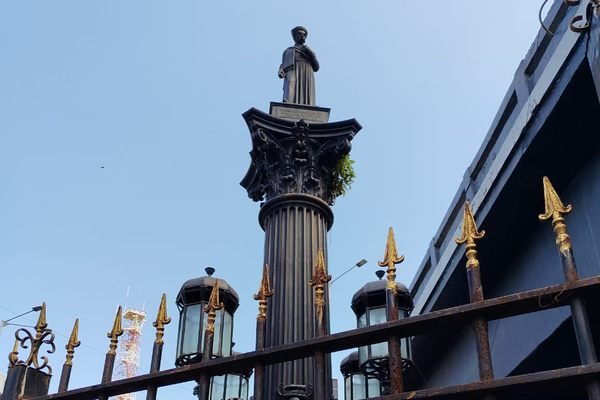
At a busy traffic junction under the Byculla Bridge in Mumbai stands a gentleman in a tall hat, balancing on a Corinthian column nearly 160 years after he was put there. Locals call him the Khada Parsi — literally the Standing Parsi — and he is actually Seth Cursetjee Manockjee (1763-1845), a Parsi businessman and philanthropist honoured with a statue by his son, Manockjee Cursetjee.
Installed in 1867, it's believed to be the third statue of an Indian person erected in Bombay, following those of Jamsetjee Jejeebhoy and Jagannath Shankarseth. Experts consider it the city's only cast-iron statue, which makes it a genuine oddity for anyone interested in colonial-era craftsmanship — most public statues of that period were marble or bronze.
The design rewards a closer look, if you can dodge the traffic. The column's base is ringed by four mermaid figures blowing conch shells, which once worked as water fountains, with four lamps set above them. After decades of grime and neglect, the statue has been restored in recent years, so the detail is far easier to appreciate than it was for most of the twentieth century.
The Khada Parsi is more than a curiosity. It shows up constantly in old paintings, fiction and city lore, often as shorthand for public life in nineteenth-century Bombay. Some residents use a slightly different name, Khara Parsi, meaning True Parsi — a small linguistic wrinkle that tells you how embedded the monument is in everyday Mumbai speech. For a traveller walking between Byculla's attractions, it's a landmark that anchors the neighbourhood's history in a single glance.
Why bother? Byculla is one of Mumbai's most interesting heritage pockets, home to the Dr Bhau Daji Lad Museum, the Victorian zoo grounds of Rani Bagh and grand decaying mansions that most visitors rush past on their way to Colaba. The Khada Parsi statue is a perfect excuse to slow down and explore an area of the city that rarely makes standard itineraries. Photographers will like the contrast of an 1867 iron figure framed by modern flyover traffic, and history buffs get a rare, documented survivor: a statue that predates most of the buildings around it and has outlasted everything from horse trams to the local train's modernisation. If you're piecing together a walking route through old Bombay, this junction belongs on it — ideally early morning, before the traffic and heat build.