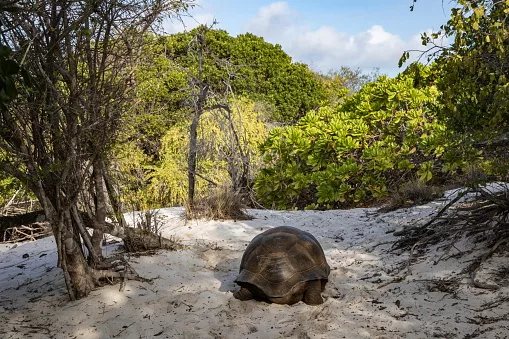
Aldabra Atoll, a remote coral atoll in the Seychelles, holds an estimated 183,000 giant tortoises, according to a new survey — the largest known population of free-roaming giant tortoises anywhere on Earth. The figure more than doubles the long-standing estimate of 100,000 animals recorded in the late 1990s.
Researchers from the Seychelles Islands Foundation and the University of Exeter worked through five years of field counts collected between 2018 and 2022, publishing their results in the journal Ecology and Evolution. Because Aldabra's dense vegetation hides plenty of animals from view, the team used population modelling to account for tortoises they couldn't see directly, producing a far more reliable number than earlier counts.
The numbers are remarkable given the species' history. During the 19th century, exploitation drove the Aldabra giant tortoise to fewer than 1,000 animals. Protection changed everything: the atoll became a strict nature reserve in 1981 and a UNESCO World Heritage Site in 1982. Today it is one of only two places on the planet where giant tortoises live wild — the other being the Galápagos Islands.
SIF chief executive Frauke Fleischer-Dogley framed the result as proof of what sustained conservation can achieve, and co-author Nancy Bunbury described the data as a baseline for tracking the population over coming decades. Counts held roughly steady during the survey period, so researchers stress that ongoing monitoring matters as much as the headline figure.
Threats haven't gone away. Climate change is expected to bring longer, more frequent droughts to the atoll, cutting into the food and shade tortoises depend on, while rising seas threaten its low-lying terrain. Feral cats and black rats prey on eggs and hatchlings, and researchers argue that removing these invasive mammals is the most practical way to shore up the population's future.
Why should travellers care? Aldabra is essentially unreachable for ordinary tourism — access is tightly restricted and requires special permission through the Seychelles Islands Foundation, with most visitors arriving via research or expedition vessels. But it's a meaningful part of any Seychelles trip conversation: the outer islands' conservation story shapes the country's eco-tourism identity, and giant tortoises can be seen more accessibly on islands like Curieuse and at conservation centres on Mahé. For divers and expedition cruise travellers, Aldabra represents one of the Indian Ocean's last untouched wildernesses — a name worth knowing even if you never set foot there.