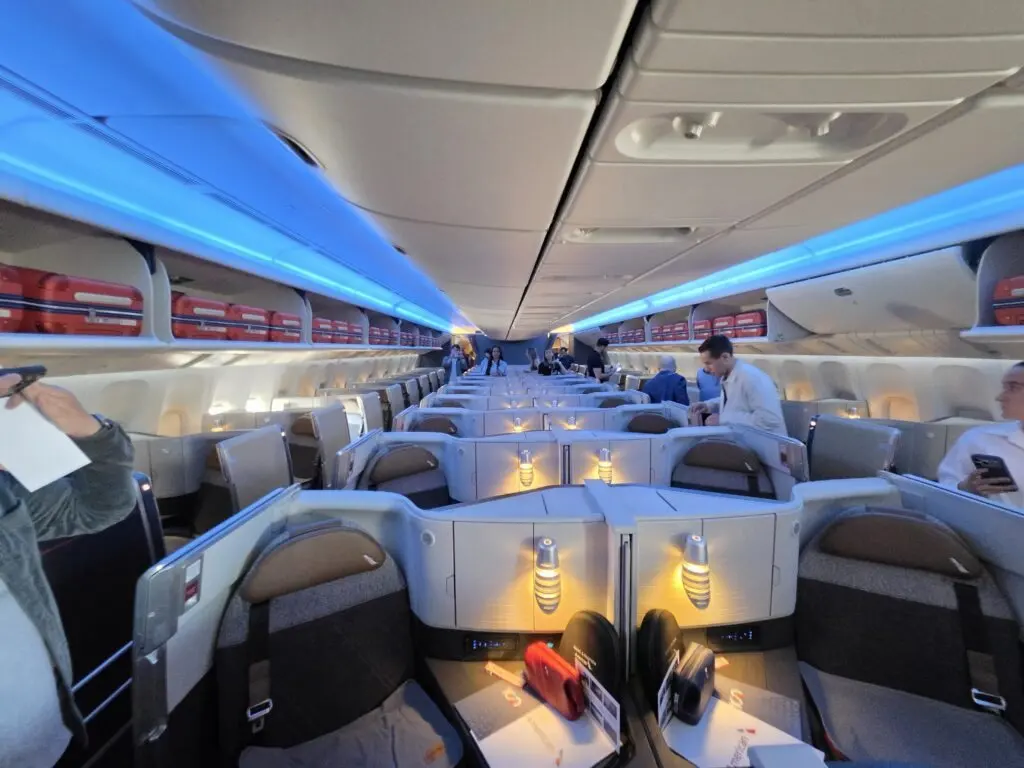
American Airlines has quietly fixed its biggest complaint. The carrier says Starlink will now be fitted to every mainline jet in its fleet — more than 1,000 aircraft, including the Boeing widebodies whose ageing Panasonic internet has long been the worst part of flying them long-haul.
The original Starlink deal, announced in May, covered only Airbus narrowbodies. That left the Boeing 737s, 777s and 787s out in the cold, which made little sense given the long-haul fleet was where the connectivity was weakest. The expanded plan now covers more than 500 Airbus narrowbodies, more than 400 Boeing narrowbodies and more than 130 Boeing widebodies — over 1,030 planes carrying more than 165 million passengers a year, with another 300-plus jets still on order.
Installs start in early 2027. American hasn't said when the rollout finishes or which Boeing types go first. And note the fine print: this is mainline only. American Eagle regional jets are not included — the two-cabin regionals recently got ViaSat service, while smaller regional jets stay offline entirely.
The hardware is Starlink's Performance Aero Terminal, advertised at up to 1 gigabit per second per terminal, shared across the cabin and available gate to gate. For context, United's first Starlink-equipped Embraer E175 ran one antenna at around 500 Mbps, while its 737-800s used two antennas for roughly 1 Gbps combined. Because Starlink's satellites orbit much closer to Earth than traditional satellite systems, latency is low enough that video calls and VPN work actually feel usable in the air.
There's a catch worth knowing as a passenger: American already offers free AT&T-sponsored Wi-Fi to AAdvantage members on its Viasat- and Intelsat-equipped planes, and service got noticeably worse once it went free and everyone logged on. Expect Starlink's extra capacity to help — but if the same free-for-all pattern repeats, speeds may dip at peak times. Whether Starlink on American will also be free for loyalty members hasn't been spelled out.
Why should a traveller care? Because connectivity is becoming the deciding factor between airlines. Delta's competing Amazon Leo deal starts at 500 aircraft with installations from 2028, and United, Southwest, Alaska and even Frontier are all moving to Starlink. American spent years stripping out perks while chasing Spirit and Frontier on price — a strategy that never suited a full-service carrier. It's since been adding back seatback screens, better lounges, improved food and more extra-legroom seating. Fast, reliable gate-to-gate internet on a 777 to Europe or Asia means you can actually work door to door, which for many business travellers is worth more than a few dollars off the fare.
American still trails Delta on operational reliability and cabin screens, and Delta One lounges remain ahead. But if you routinely pick flights based on whether you can stay productive, the gap on connectivity is about to close — assuming the 2027 rollout delivers on time.