
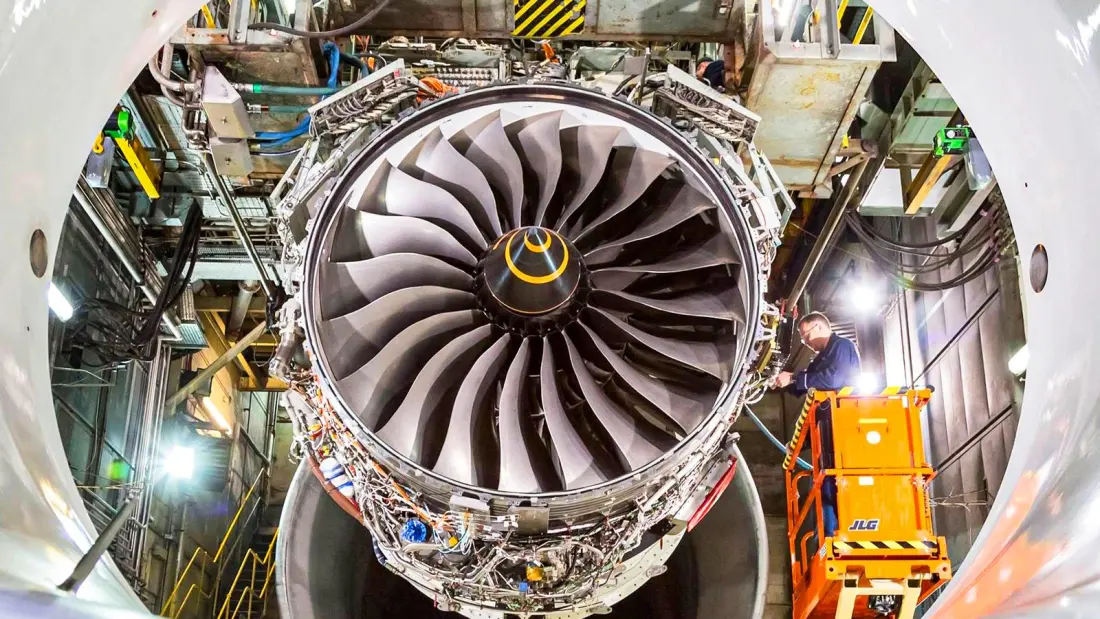
Before any turbofan is allowed to carry passengers, it has to be deliberately destroyed on a test stand — repeatedly, and on camera for regulators. The FAA's 14 CFR Part 33 rules (mirrored in Europe by EASA's CS-E standards) demand proof that when an engine fails catastrophically, the failure stays inside the casing and the engine stays attached to the wing.
The most famous trial is the bird strike test. Technicians use compressed-air cannons to fire actual bird carcasses into a running engine at full takeoff power, with the fan spinning at up to 3,500 RPM. Engines facing small and medium flocks must keep producing thrust for at least 20 minutes so a crew can make an emergency landing. For a single large bird, the rules flip: the engine can lose all thrust and wreck itself internally, but no debris may escape the casing, no fire may spread, and the mounts must hold.
Then there's the fan blade-off test, arguably the most violent of all. At sites like GE Aerospace's outdoor facility in Peebles, Ohio, small explosive charges are embedded in a blade root and detonated at full power, slicing off a titanium or composite blade and hurling it into the casing at over 600 mph. The containment case — often titanium armour or Kevlar-wrapped composites, the fabric used in bulletproof vests — must absorb the impact and the resulting chain of secondary debris. The engine also has to endure more than 50,000 pounds of off-axis centrifugal load for at least 15 seconds without burning or detaching.
Weather gets its own torture chamber. Water walls spray thousands of gallons per minute into the intake to prove the combustor won't flame out in a tropical downpour, while compressed-air guns fire ice balls up to two inches across at the spinning fan. Cold-weather stands build heavy ice on blades and spinners to confirm shedding chunks won't wreck the compressor. The finale is a 150-hour endurance run: 25 back-to-back six-hour blocks at redline temperatures and overspeed limits.
The GE9X, the largest commercial turbofan ever built, went through five years of this with eight test engines, logging around 5,000 hours and 8,000 cycles before FAA approval. The process doesn't always go smoothly, and that's the point. In 1970, Rolls-Royce's carbon-fibre fan blades for the RB211 shattered in bird testing, forcing a titanium redesign that delayed the Lockheed L-1011 and pushed the company into receivership. In 2019, the GE9X failed its own endurance runs when stator vanes showed premature heat wear, delaying both certification and the Boeing 777X programme.
Why should a traveller care? Because this is the machinery behind the statistic that engine failures are extraordinarily rare across billions of passenger miles. Every blade shattered on a test rig in Ohio is a failure that will never happen at 35,000 feet with you on board. When you hear about an aircraft's safe diversion after a bird strike or a contained engine shutdown, that's Part 33 doing its job decades earlier.