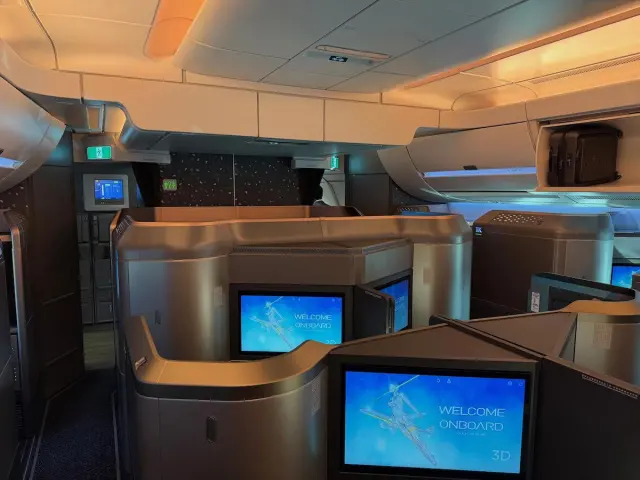
Premium economy was supposed to be the sweet spot of long-haul flying: a wider seat, a footrest, better food, at a fraction of business class prices. But a quieter product is eating its lunch — the humble extra-legroom economy seat. A recent analysis by Simple Flying lays out five reasons why travellers are increasingly skipping dedicated premium economy cabins, and why airlines are quietly happy to let it happen.
The economics start with floor space. On a Boeing 787, a true premium economy cabin means dropping from nine-abreast seating to seven-abreast with around 38 inches of pitch — a costly hit to passenger density. Extra-legroom economy keeps the dense nine-abreast layout and simply stretches pitch to 34 or 35 inches. Airlines can flip rows between standard and extra-legroom with minimal engineering work, capturing extra fees from budget-conscious flyers without locking jets into low-density layouts.
Price is doing the rest. Premium economy cabins are deliberately small — usually 21 to 28 seats per wide-body — so supply stays fixed while demand climbs. Round-trip fares on key transatlantic and transpacific routes now hit $2,500 to $3,500, versus roughly $800 in standard economy. Meanwhile, an extra-legroom seat typically adds just $100 to $250 per long-haul segment, landing a total fare around $1,000 to $1,300. For self-funded travellers, knee room at less than half the price is an easy call.
Airlines also have themselves to blame for the confusion. Through the 2000s, US carriers branded standard seats with a few extra inches as 'Main Cabin Extra' or 'Economy Plus', training a generation of flyers to equate the word 'premium' with basic legroom. When American Airlines launched the first proper US premium economy cabin in 2016, it inherited a muddled brand message. European and Asian carriers like EVA Air and Virgin Atlantic had spent two decades establishing premium economy as a genuinely separate class — US airlines never built that distinction.
The convergence is getting tighter. Air New Zealand now offers 35-inch pitch in some extra-legroom rows, and JetBlue's EvenMore goes up to 38 inches — the same pitch as many premium economy cabins, without the wider seat or upgraded dining. Add opaque financial reporting — Delta lumps Comfort+ in with Premium Select and Delta One, posting $5.70 billion in premium cabin revenue in Q4 2025 — and airlines have little incentive to clarify which product is really winning.
For travellers, the takeaway is practical: measure the pitch, not the label. If your priority is legroom rather than a wider seat and multi-course meals, an extra-legroom seat can deliver most of the comfort of premium economy for a fraction of the fare. If you want the full experience — dedicated cabin, recline, priority service — book early or use points, because cash prices on popular long-haul routes keep climbing. Corporate travellers with generous policies will keep premium economy full; everyone else has a cheaper exit row waiting.