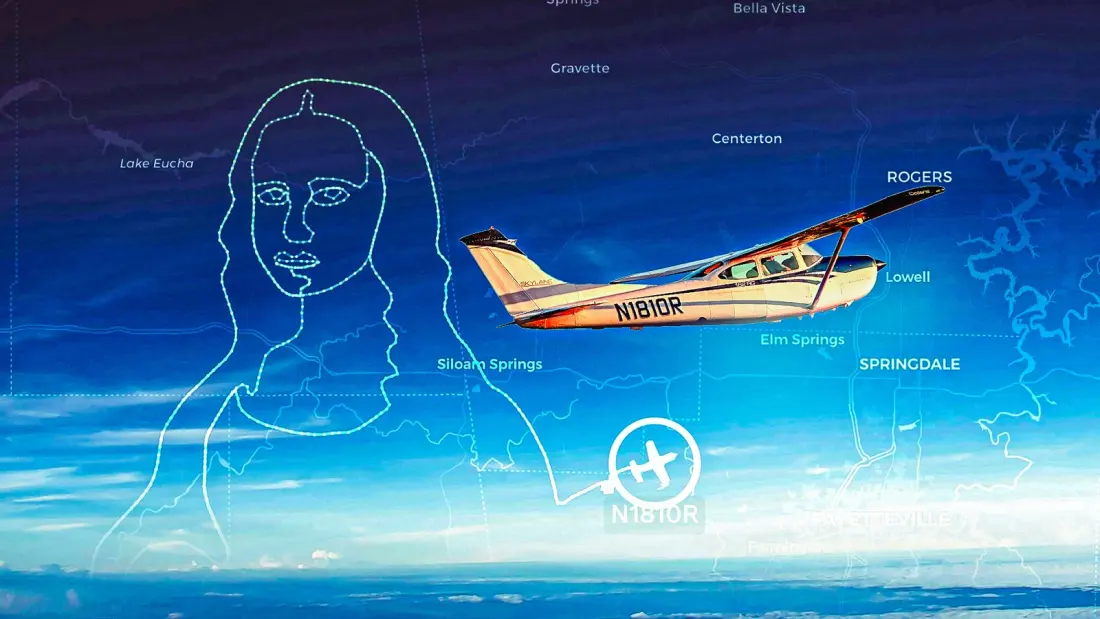
If you pulled up flight-tracking data on the right day, you might spot something odd over the American countryside: a Cessna tracing the outline of Leonardo da Vinci's most famous portrait. That's Benjamin McDaniel, a pilot who has turned flight paths into an art form, culminating in a full aerial rendition of the Mona Lisa.
McDaniel came to aviation in 2020 after a discovery flight rerouted his life. He studied Aviation Management at Auburn University, then built hours as an instructor — first at Auburn, later at WaterWings Seaplane School teaching multi-engine sea and land. Around autumn 2023, he started drawing simple shapes and words with his flight track as a way to stay sharp between instructing gigs. It escalated. A Lord of the Rings piece in summer 2026 drew attention online, and then came the Mona Lisa, which he calls the most ambitious project he has finished.
The method is more craft than gadgetry. McDaniel plans each piece in ForeFlight with an Apple Pencil, working out whether every line can become a real sequence of headings, distances and turns in his Cessna R182 Skylane RG. Crucially, he doesn't program GPS waypoints — he hand-flies everything. If a segment can't be flown cleanly and safely, it doesn't make the plan. The Mona Lisa took longer to plan than to fly, largely because a human face has no room for wobble, and the whole design has to work as one continuous path. There's no pausing mid-drawing to reposition.
Once airborne, the aircraft sets the constraints: speed, endurance, fuel, weather and focus. The flights run as ordinary VFR operations — no special clearance needed, provided he stays clear of restricted airspace — though he monitors nearby ATC frequencies and the local airport CTAF so he can talk to traffic when required. Weather has scrubbed a few attempts before takeoff, but he has never abandoned a design once in the air. His verdict on the pressure: these flights take a few hours, you get one shot, and there are no redos. A single early or late turn, and Mona Lisa stops looking like Mona Lisa. His full Spider-Man drawing was similarly unforgiving.
There's a lineage here. Skywriting dates to the early 1920s, when Captain Cyril Turner demonstrated it over England's Epsom Downs before writing "Hello U.S.A." over New York. Pepsi ran an enormous skywriting operation, contracting 2,225 messages in 1940 alone, with pilot Suzanne Asbury-Oliver spending over two decades writing ads across North America. In 2019, EL AL's farewell Boeing 747 flight from Rome to Tel Aviv traced a jumbo-jet outline over the Mediterranean using more than 80 waypoints. McDaniel's twist is doing it all by hand in a light aircraft, with Flightradar24 and its ilk turning the finished track into a shareable image.
Why should a traveller care? Because it's a reminder that the tracking apps we use to check delays can also reveal genuine creativity — and if a strange shape shows up on your map, someone worked hard for it. McDaniel takes commissions via his social handle, @thepilotpicasso.