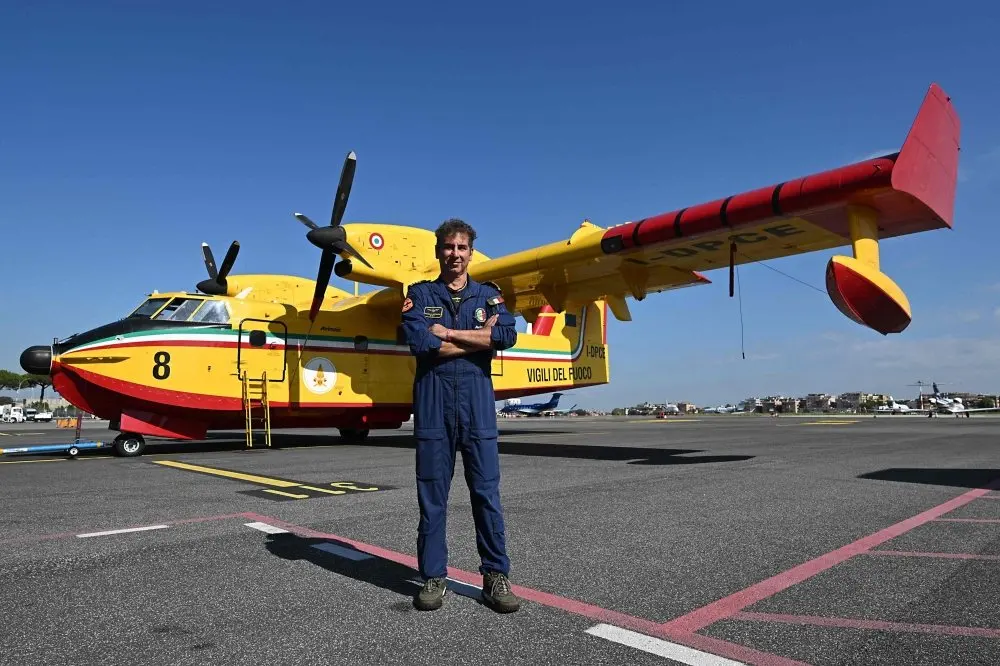
The bright red-and-yellow Canadair planes that spent the summer skimming Italian lakes and coastlines have landed back at their base near Rome for a well-earned overhaul. For anyone holidaying around the Mediterranean this year, those aircraft were the reason some fire scares stayed scares.
Italy runs one of the biggest Canadair fleets in the world, managed by Avincis on behalf of the national fire service. The planes are part boat, part aircraft: they scoop up more than 6,000 litres of water in 12 seconds without landing, using two intakes under the fuselage, then drop the load in three seconds. That ability to refill on the move makes them unusually fast to deploy — pilot Francesco Morgante calls the type an ideal tool for containing fires that are already fully developed.
The 2026 season tested them hard. EFFIS data puts it as Italy's fourth-largest fire season since 2006: 113,800 hectares burned across 645 fires. And the fleet wasn't only fighting Italian blazes. Under the EU's shared firefighting pool, the planes started the summer in Portugal and Spain, both hit by fires that threatened cities and tourist areas, before an unexpected emergency in northern Italy demanded their full attention.
The context is sobering. Western Europe just recorded its hottest summer on record, and roughly 540,000 hectares burned across the EU between mid-June and early September. Morgante noted the crews never got their usual breathing space — the summer storm that drops the temperature a few degrees and gives everyone a two-day pause simply never arrived. Operations ran from first light to dusk, according to Alessandro Sette, who runs the operations room fielding requests from Italy's Civil Protection agency.
All 18 water bombers are now undergoing in-depth inspections in a newly renovated hangar near Rome, with maintenance expected to wrap up by March. The last temporary base, in Calabria, closes on 31 October — the official end of the season. Italy flies the CL-415 model, built exclusively by Calgary-based De Havilland, and like much of Europe is waiting on the new-generation DHC-515, which runs about €100 million per aircraft. Demand for these planes, Morgante says, has been climbing slowly but steadily for years.
Why should travellers care? Because fire risk is now a genuine planning factor for Mediterranean holidays. If you're heading to Italy, Portugal, Spain, Greece or southern France between June and September, it's worth checking local fire alerts, respecting fire bans in countryside and campsite settings, and knowing that thick smoke can close roads and disrupt coastal plans even far from the flames. The EU's shared fleet exists partly to protect the very regions tourists flock to in summer — and this summer showed it working flat out.