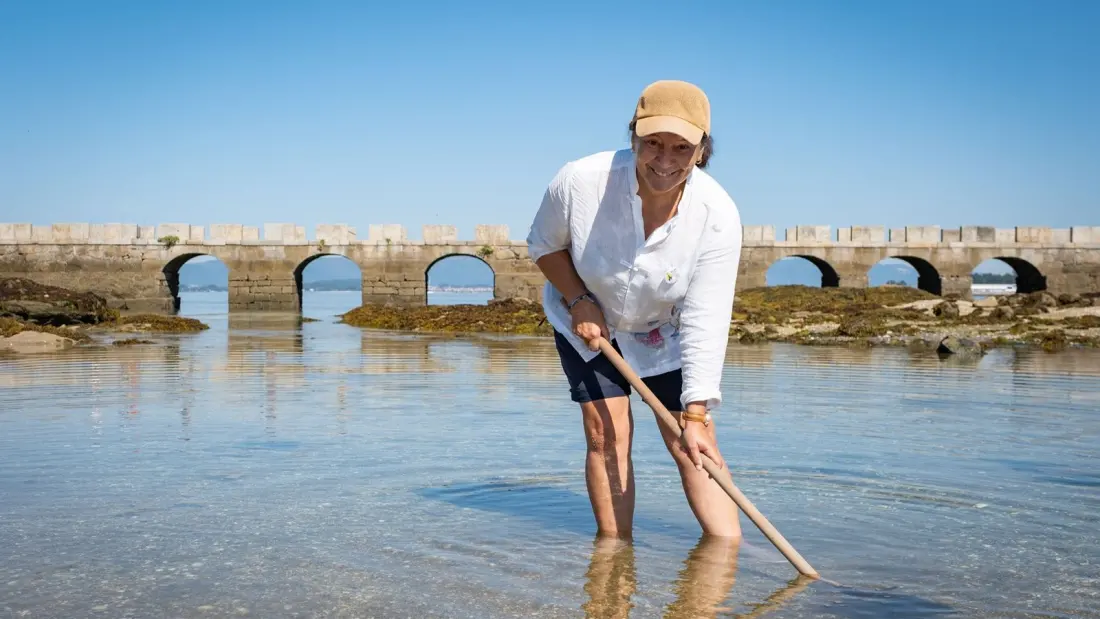
The first thing Charo Oliveira-Dominguez says when she greets visitors from the streets of Cambados is 'welcome to my office' — and her office is a tidal flat on the west coast of Galicia, where she has spent 27 years pulling clams out of the sand. She's one of the town's mariscadoras, women shellfish gatherers whose trade goes back roughly a thousand years, and whose story took a remarkable turn in the last three decades.
It wasn't always a respected job. Historically, shellfish gathering fell to women from poorer families while men fished the deep sea; the women worked the shore because it let them combine harvests with childcare. Charo's mother started at age seven and was once jailed during conflicts over unregulated harvesting. Before 1995, the work wasn't even recognised as a profession — just something women did to top up the household income.
Regulation changed everything. Since 1996, mariscadoras have needed a five-year licence from Galicia's regional government and training in managing the inter-tidal zone. Today, 32 legally constituted groups sit on the regional fishing board, pay is standardised, and in Cambados about 200 women are licensed — four times the number in Charo's mother's era. An EU-backed organisation, Guimatur, founded in 2004, promotes their marine tourism and coastal conservation work. Far from dying out, the tradition now offers a decent living, boosted by guiding visitors. Even the selling is modern: barcoded tubs go to the town's auction market, the lonja, and Charo tracks her earnings on an app.
The harvesting itself is strictly controlled. Clams must measure at least 4 cm — the size at which each animal has reproduced at least once — so populations stay healthy. Gatherers work around 15 days a month, five hours a day, a schedule dictated by tides and the moon rather than a boss. They rake for cockles, grooved-carpet shells and Japonica clams, working in teams of five and sharing catches when someone has a weak day.
Travellers can now meet the mariscadoras themselves through a new experience added to Intrepid's Northern Spain Real Food Adventure. The outing includes a briefing on mollusc species, a wade onto the sands with a pronged rake, and a visit to Real Espanola Conserva, an all-women artisan cannery near Cambados, where the reward is sardines in olive oil, mussels in a secret tomato-pepper sauce, clams and local Albariño. Clams, it turns out, earn their superfood label twice over: rich in B12 and iron, and harvested in a way that keeps the marine ecosystem in balance.
This story suits food-focused travellers and anyone curious about female-led traditions that genuinely thrive — not as a museum piece, but as a modern, sustainable livelihood you can see, and taste, up close.