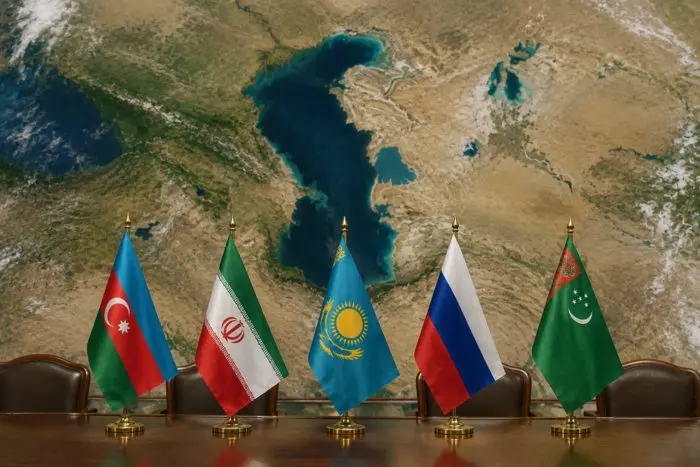
Leaders of the five countries bordering the Caspian Sea — Azerbaijan, Iran, Kazakhstan, Russia and Turkmenistan — gathered on October 9 in Avaza, Turkmenistan's national tourist zone on the Caspian coast, for a summit dedicated to the sea's most pressing problem: it is getting smaller.
The numbers behind the concern are stark. Kazakhstan's hydrometeorological service recorded a 1.76-metre drop in sea level between 2005 and 2022, with the water surface shrinking by more than 26,000 square kilometres. Roughly half of that lost area was in Kazakhstan's shallow Northern Caspian, where the shoreline has retreated by over 25 kilometres in places. Scientists cited by the OECD and World Bank point mainly to increased evaporation as temperatures rise, along with changing river flows — the Volga alone supplies about 80% of the sea's inflow.
The Avaza meeting was the centrepiece of a busy three-day run (October 7-9) that also brought together environmental ministers, Central Asian and Azerbaijani heads of state, and the CIS heads of state council. For travellers who know Avaza as a beach resort strip, it is an unlikely setting for heavyweight geopolitics — but the stakes reach well beyond ecology.
Falling water levels threaten ports, fisheries and wildlife, including the endangered Caspian seal and sturgeon. They also complicate the booming Middle Corridor (Trans-Caspian International Transport Route), where freight volumes have grown 5.6-fold in five years to 4.5 million tons, and Kazakhstan plans to expand port capacity from 21.8 to 30 million tons by 2030. Shipping conditions and coastal infrastructure now depend on how fast the sea keeps receding.
Steps are already in motion. The Tehran Convention — the binding environmental pact among all five littoral states — launched a Caspian Sea Level Fluctuation Action Plan for 2026-2036, and a four-year, $11.7 million Global Environment Facility project called Blueing the Caspian Sea is funding pollution monitoring and biodiversity work in Azerbaijan, Kazakhstan and Turkmenistan. Experts quoted ahead of the summit said real success would look like a costed plan with deadlines, shared data standards and coordinated port adaptation — not bold promises to refill the sea.
For anyone travelling the Caspian region — whether to Avaza's resorts, Kazakhstan's receding northern shoreline or the ferry routes of the Middle Corridor — this is a coastline visibly in motion, and the next decade of cooperation will shape what it looks like.
Reported by The Astana Times.