Vietnam pulled in more than 17.7 million international visitors in the first nine months of the year, up 14.5% on the same period last year. That puts the country at roughly 71% of its full-year target of 25 million foreign arrivals, with September alone adding 1.77 million visitors — a 16.1% jump year-on-year, according to the Vietnam National Authority of Tourism.
The mix of source markets is shifting in interesting ways. China (3.9 million) and South Korea (3 million) still dominate, together making up nearly 40% of all arrivals. But the real headline is Russia: arrivals surged 160% to just over one million, making it Vietnam's largest European market. Russians are booking beach holidays, long stays and winter escapes, and improved flight links plus expanding resort capacity have fed the boom. Europe overall grew 55%, with Poland (+49%), Switzerland (+25.7%) and Germany (+16.1%) all posting solid gains. India is another fast riser at +33%, while Southeast Asian neighbours like the Philippines (+55.2%) and Cambodia (+40.5%) are sending far more travellers than before. Not everything is up, though — South Korean arrivals slipped 5.5% and China grew just 1.5%.
What makes this notable is the global backdrop. UN Tourism reckons international travel grew just 0.4% in the first half of the year and has cut its full-year forecast to 1–2%. Vietnam's double-digit growth against that trend says a lot about its pull: it's seen as safe and stable, flight connectivity keeps improving, and the product range — beaches, heritage cities, street food, mountain treks — is broad.
The accolades are piling up too. The World Economic Forum's latest Travel & Tourism Development Index gave Vietnam a score of 4.15, up 6.3% from 2024 — the second-fastest improvement of any country — lifting it seven places to 52nd in the world. At the 2026 World Travel Awards for Asia, Oceania and the Indian Ocean, Vietnam was named Asia's Leading Destination and Asia's Leading Heritage Destination.
The interesting part of the story is where the sector wants to go next. Tourism officials are openly saying the goal is no longer just visitor volume but value: longer stays, higher spending, and richer experiences built around the country's food, heritage and living culture. Policy direction from Politburo Resolution 80, issued in January, puts cultural identity at the centre of national development — and tourism is expected to reflect that.
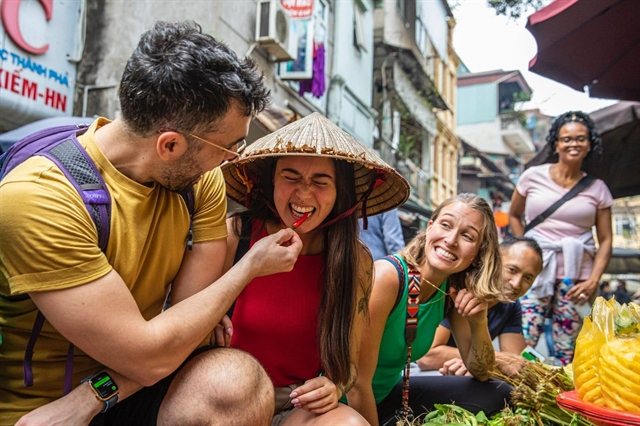
For travellers, this matters in practical ways. Expect continued investment in resorts, flights and experiences beyond the usual Hanoi–Ho Chi Minh City–Halong Bay circuit, with places like Da Nang, Hoi An, Nha Trang and Phong Nha getting more attention. Popularity also means the classic sights are busier, so shoulder seasons (April–May, September–November) are the smart window for good weather without peak crowds. And as the country leans into cultural depth, food tours, craft villages and regional festivals are becoming easier to find and book — well worth building into a trip rather than treating them as an afterthought.