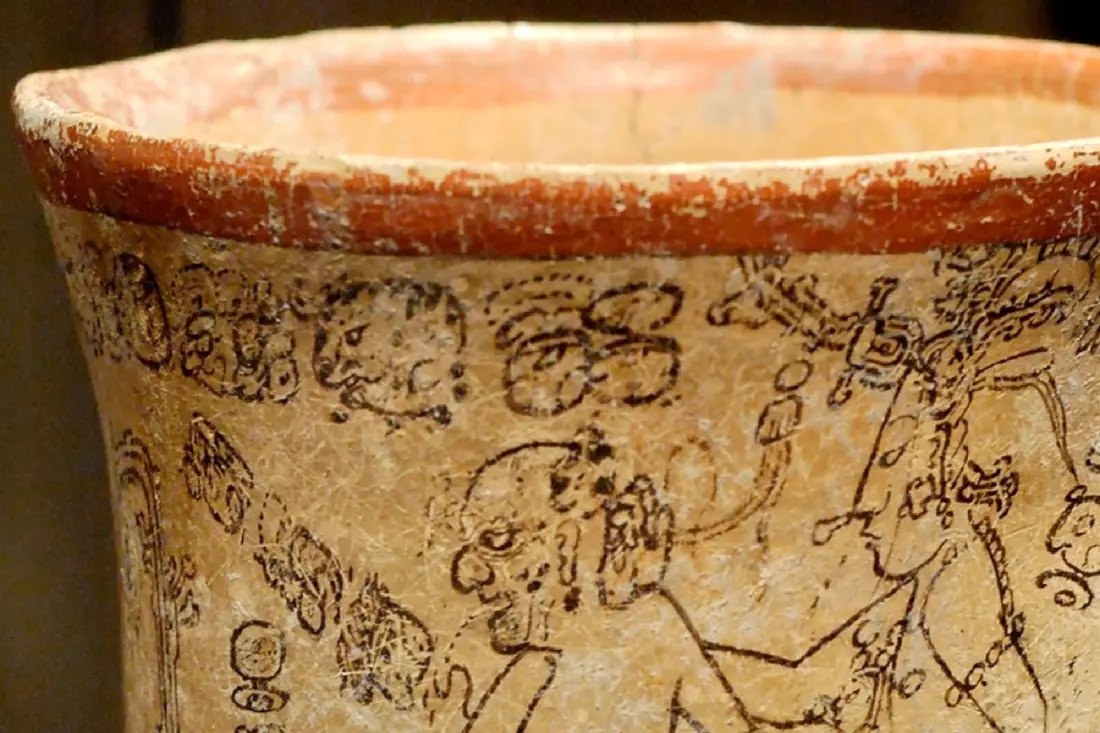
No one knows where it is. But a 1,200-year-old Maya vase — catalogued as U0186 — has just told researchers a surprising amount about the political unraveling of the Classic Maya world, purely on the strength of old photographs.
The vessel belongs to the Holmul Dancer tradition, a style of painted ceramics from what is now northern Guatemala and western Belize. Archaeologist Joanne Baron tracked its history through photographic archives at Dumbarton Oaks in Washington, D.C., and published her findings in Ancient Mesoamerica, a Cambridge University Press journal. The photos suggest the vase was looted from Belize in 1979 and sold for US$14,000 before vanishing. Its imagery, dated to around 812 C.E., points to a probable origin in western Belize, possibly near the ancient site of Baking Pot.
What makes the vase interesting is who's painted on it. It shows multiple versions of the dancing maize god — a central figure in Maya mythology tied to death, rebirth and farming — but their costumes and inscriptions tie them to different political centres. One figure connects to Tikal, another to Rio Azul, and a third to a place called Yoyoon, which may never before have appeared in the known Maya hieroglyphic record. Mixing three powers on a single vessel was not standard practice. Baron reads it as evidence of a splintering political order: by the early ninth century, the old superpowers — Tikal and the Calakmul-Dzibanche dynasty — were losing their grip, and smaller centres were asserting themselves.
The timing matters. Around this period, many kingdoms in the southern Maya lowlands slid into crisis. Monument building slowed, inscriptions dried up, rulers lost authority and major cities were eventually abandoned. Archaeologists still argue over what drove the so-called Maya collapse — the evidence points to a messy mix of war, environmental stress and economic disruption rather than one dramatic event. Baron's take is that extra maize-god figures on ninth-century pottery may reflect communities gaining autonomy from the old hierarchies. And the collapse was uneven anyway: some places faded while others stayed politically relevant for centuries.
There's also a practical side to the story. U0186 shows why archaeological archives matter — even when an artefact disappears into private hands, photographs can preserve enough detail to reconstruct its date, origin and context. If the vase ever resurfaces, Baron's research could help prove its provenance and support Belize's claim for its return.
For travellers, this is a good excuse to look beyond the headline ruins. Tikal in Guatemala draws the crowds, but western Belize — the area where this vase likely came from — has its own rewarding sites like Xunantunich and Cahal Pech, plus active digs around Baking Pot in the Belize River Valley. The story also explains why museums worldwide are under pressure over looted antiquities, a debate any visitor to pre-Columbian collections will run into.