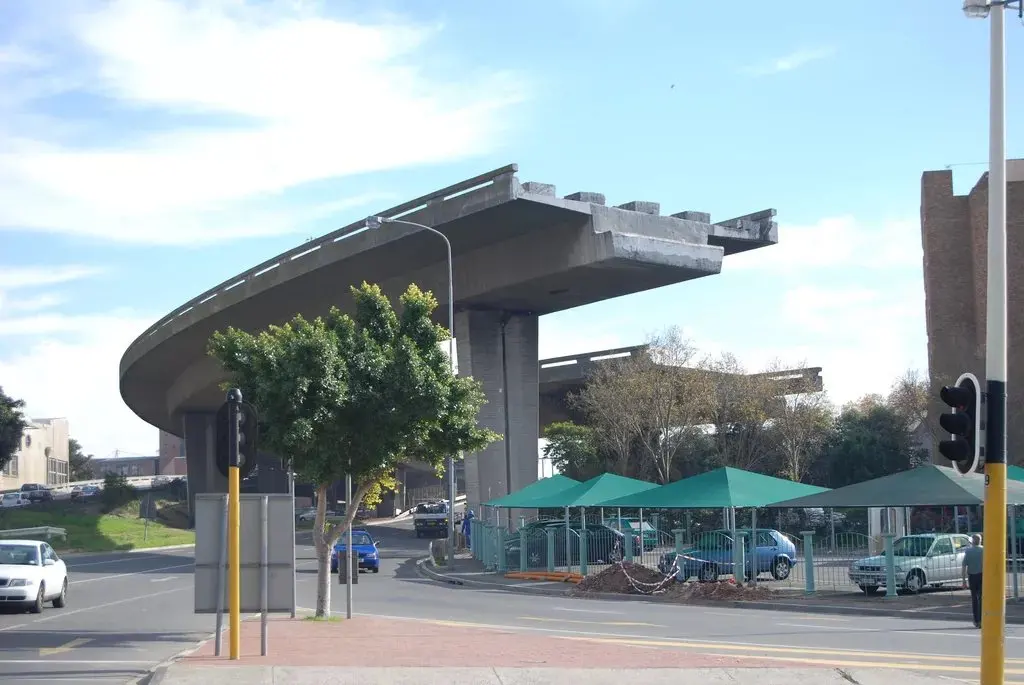
Cape Town has carried a strange monument on its skyline for over five decades: a set of unfinished elevated freeways at the Foreshore, left dangling mid-air since an ambitious highway scheme ran out of money in the 1970s. They've become a city landmark in their own right — part joke, part urban scar. Now the City of Cape Town says it has an actual plan for them, and it's a big one.
The proposal has two phases. First up: a new bridge over Buitengracht Street linking the inbound freeway with Helen Suzman Boulevard, so drivers heading for Green Point and Sea Point can skip the city centre entirely. Extra freeway lanes and bus-priority lanes are part of the deal, and a park would sit beneath the new bridge, with a canal connecting Buitengracht Park to the V&A canal.
Phase two is the boldest part: a second outbound bridge plus an underground tunnel tying the Foreshore into the N1 and N2. If it all gets built, the existing elevated outbound freeway could come down altogether. That demolition matters more than it sounds — taking it away would free up roughly 15 hectares of land that has sat half-empty since the freeways stalled. The city's vision for that space includes housing (some of it affordable), businesses, restaurants, parks, a tree-lined harbour promenade, and proper walking and cycling routes. In short: reconnecting a chunk of the waterfront that's been severed from the city by concrete since the seventies.
Don't book flights around it just yet. The scheme is still at planning stage, with public consultation, detailed design work, funding and approvals all outstanding. The city hopes to start construction of phase one in the next Council term, while phase two could stretch towards 2040. So if you're visiting Cape Town any time soon, the famous stranded on-ramps will still be there, looking exactly as they have for 50 years.
Why should travellers care? The Foreshore sits between the CBD, the V&A Waterfront and the Atlantic seaboard — the routes nearly every visitor uses. If the plans land, the drive from the airport or the N1 into town gets less congested, and a walkable, green Foreshore district with food and housing could become a genuinely new part of the city to explore. Even now, the area around the Waterfront and Green Point is easy to enjoy, and the unfinished highways are worth a look simply as one of the strangest pieces of urban history in South Africa. Change, finally, is on the horizon — just a very long horizon.