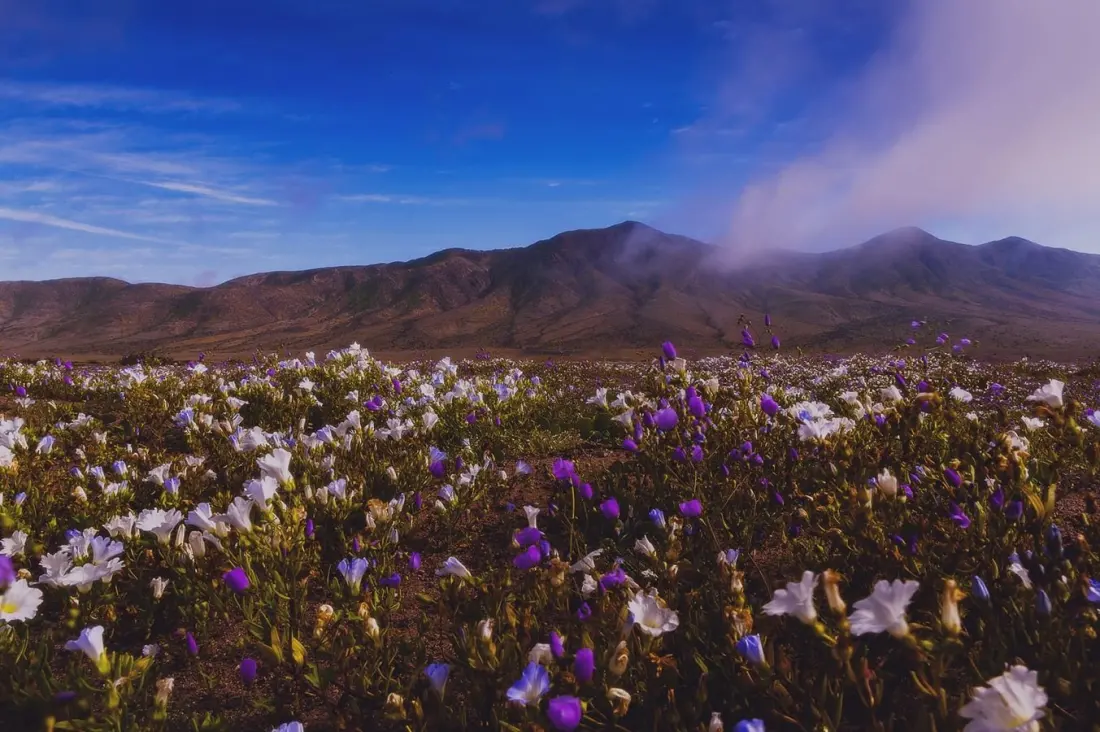
One of the driest places on the planet has turned into a field of colour. Northern Chile's Atacama Desert, which normally gets almost no rainfall at all, is experiencing its largest 'flowering desert' event since 1997, thanks to heavy rains linked to El Niño.
The numbers are remarkable. While the phenomenon usually kicks in when coastal areas of the Atacama Region receive more than about 15 millimetres of winter rain, some spots recorded 160 to 190 millimetres this year. Vallenar logged 183.5 millimetres — an extraordinary figure for a region built around aridity. That was enough water to wake up millions of seeds, bulbs and tubers that had been lying dormant underground, in some cases for decades.
Chile's National Forestry Corporation (CONAF) says more than 200 plant species have emerged, covering slopes that had gone 30 to 40 years without showing vegetation. Expect to see red and yellow añañucas, white suspiros, orange terciopelos, purple blooms and the emblematic lion's paw flower. The display could stretch across roughly 17,000 square kilometres — an area comparable to Santiago's Metropolitan Region — and became visible through the Southern Hemisphere spring, with the phenomenon expected to wrap up by November.
Unsurprisingly, people are flocking to see it. Chilean tourism authorities estimate nearly 300,000 overnight trips to the region before the bloom ends. But there's a catch for visitors: this is an extremely fragile ecosystem. Authorities are asking travellers to stick to established roads and trails and to avoid driving or walking over vegetated ground, since trampling this year's flowers destroys the seeds that make future blooms possible.
If you've ever wanted to watch a desert come back to life, this is a rare, time-limited window — the Atacama won't look like this again for years, possibly decades.