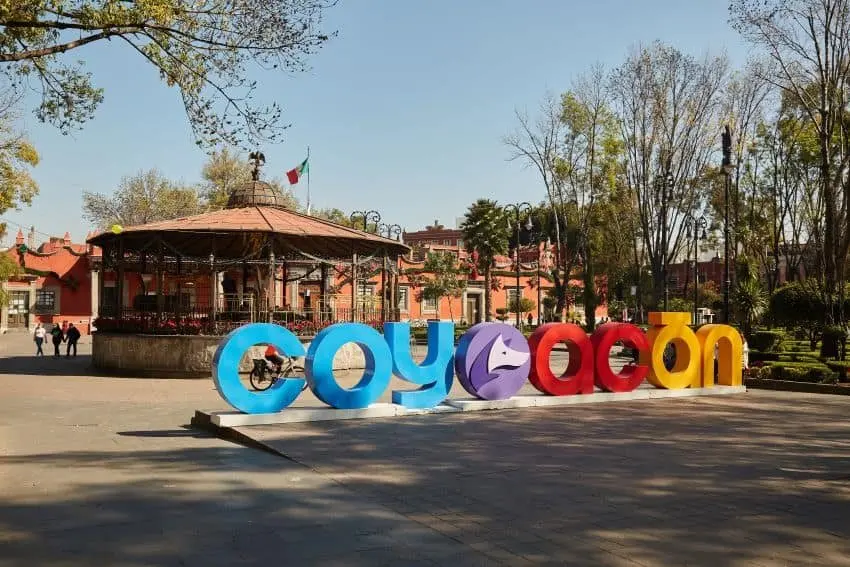
South of Mexico City's Angel of Independence sits a neighbourhood that was once the first capital of New Spain. Coyoacán — Nahuatl for "place of coyotes" — became Spanish headquarters during the conquest of the Mexica Empire in 1521, thanks to its spot on Lake Texcoco and fertile surrounding land. It stayed an independent municipality until 1857 and only lost its semi-rural feel when the capital's sprawl swallowed it in the late 19th and early 20th centuries. Today it's officially a Barrio Mágico and still sits at the physical heart of the metropolis.
The area has long attracted creative heavyweights: Frida Kahlo, León Trotsky, Octavio Paz and Rufino Tamayo all lived here. That legacy still shapes the vibe — young families, artists and UNAM students mix with families who've been there for generations, giving the place an easy bohemian energy.
Weekends are when Coyoacán really switches on. Food carts sell churros and esquites, live music fills Plaza de La Conchita, and there's a neighbourhood dance party in Jardín del Arte Allende on Sunday evenings. A smaller Saturday art market operates in Plaza Allende if you want something lower-key than the famous San Ángel version. Start your sightseeing at the twin squares of Plaza Hidalgo and Plaza de La Conchita, joined by Calle Higuera — said to be the first street the Spanish laid out. Some claim the church between them is Mexico's oldest.
Kahlo's Casa Azul is the big draw, but book ahead — reservations are required. The Trotsky Museum occupies the house where the exiled revolutionary was killed with an ice pick, and the 16th-century Church of San Juan Bautista remains the barrio's spiritual core. Avenida Francisco Sosa, a tree-lined street of colonial architecture and galleries, leads past Casa Alvarado (Paz's last home, now the National Sound Archive) to the National Watercolor Museum. For green space, Viveros de Coyoacán is a 39-hectare tree nursery with walking trails — note that bags are searched and food isn't allowed in. Worth venturing further into the borough: Diego Rivera's Anahuacalli Museum and the UNAM central campus, a Unesco World Heritage Site since 2007.
Eating here is a serious pleasure. Tostadas de Coyoacán in the main market piles ceviche and cochinita pibil onto crisp tortillas; Tacos Chupacabras is a legendary stand serving chorizo-and-carnitas "Chupa Cabra" tacos; Mi Compa Chava draws constant queues for Sinaloan seafood; and Los Danzantes, sister to a Michelin-starred Oaxaca restaurant, sits right by the Coyote Fountain in Jardín Centenario.
If you like Spanish colonial facades, street festivals and a genuinely local atmosphere rather than a polished tourist district, Coyoacán belongs near the top of any Mexico City itinerary. And if you want a quirky detour, hunt down Callejón del Aguacate — Avocado Alley — where a grim 1930s legend involving a soldier, a boy and a Virgin Mary statue still gives visitors chills.