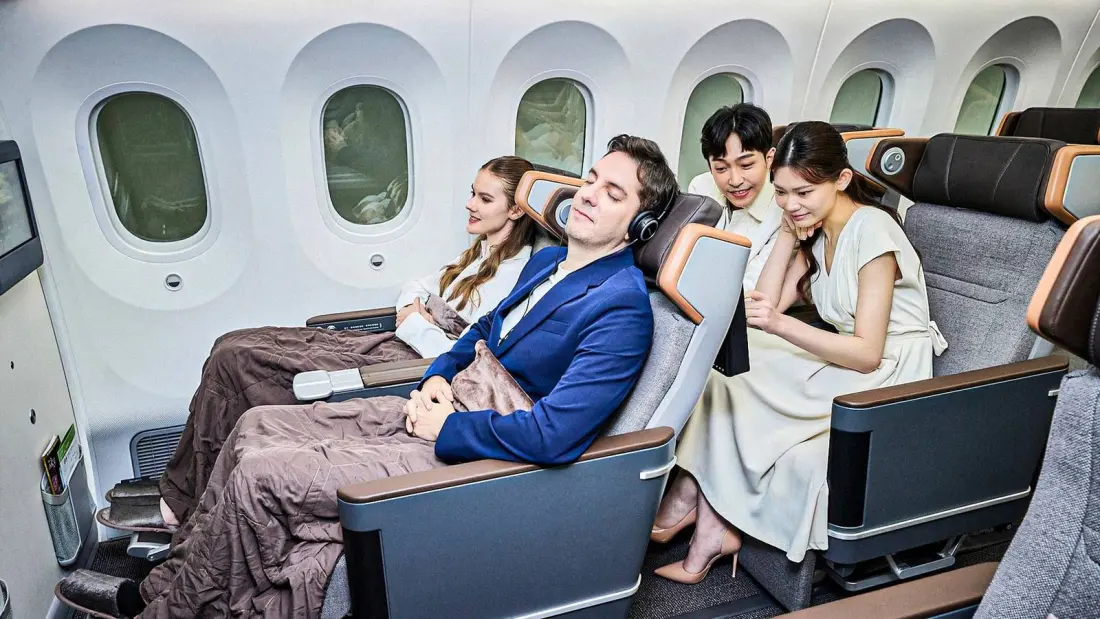
Taiwan's EVA Air has a quiet claim to shaping modern long-haul flying: it pioneered premium economy, and three decades later it still leads the category on pure space. In 2025 the carrier rolled out a fourth-generation premium economy seat on its Boeing 787-9s with an industry-leading 42-inch seat pitch in a roomy 2-3-2 layout — a layout decision that sacrifices seats for comfort in a market where almost nobody else does.
The idea dates to 1992, when EVA launched "Evergreen Deluxe Class" on Taipei–Los Angeles flights aboard its new 747-400s: 38 inches of pitch in a 2-4-2 configuration, wider cushions, upgraded meals and personal seatback screens at a time when most cabins shared a few overhead monitors. Virgin Atlantic launched a strikingly similar product the same year — its "Mid Class" became premium economy by 1994 — and the two airlines still share a friendly dispute over who truly invented the tier. Either way, it took the rest of the industry nearly 30 years to catch on universally.
Catch on it has. The number of international carriers offering premium economy grew from 42 in 2017 to 63 by 2022, and the sector was valued at $8.2 billion in 2024, projected to hit $18.7 billion by 2033. Even Emirates, a longtime holdout, is now retrofitting A380s, 777s and A350s with the cabin. The economics explain the rush: premium economy takes up far less floor space than a business class pod but earns some of the highest revenue per square foot anywhere on the aircraft.
Against that crowded field, EVA's new benchmark stands out. Japan Airlines, ANA, Singapore Airlines, Cathay Pacific and Air France all typically stick to 38-inch pitch — and often denser 2-4-2 seating on A350s and 787s. EVA's 42 inches beats what many airlines offer in short-haul business class, and its seats use a cradle mechanism that reclines a full eight inches by sliding the cushion forward and up, so the person behind doesn't lose their space.
For travellers, the practical lesson is that premium economy is not one product. On a 14-hour transpacific flight, a seven-abreast 2-3-2 cabin with 42-inch pitch is a categorically different experience from an eight-abreast 2-4-2 with 38 inches, even if both carry the same marketing label. EVA's cabin suits two groups especially well: leisure flyers willing to pay roughly double economy fares for a genuinely restful ride, and business travellers whose company policies rule out business class but who still need to arrive able to work. If you're booking a long-haul trip and the fare gap is reasonable, checking seat pitch and cabin width before you pay is the difference between a comfortable flight and an endurance test.
The category's inventor, fittingly, remains its leader.