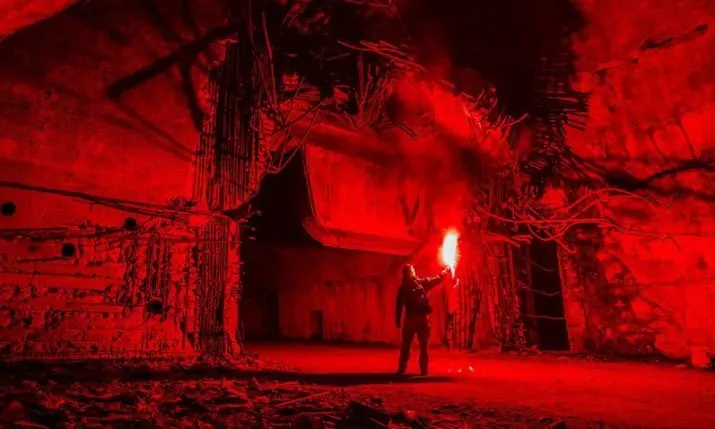
A four-part Croatian documentary called Ispod radara (Under the Radar) is giving television audiences a rare look inside the underground world of the Cold War — and it doubles as a field guide for anyone keen to explore these sites in person.
Produced by Creative Objective for national broadcaster HRT, the series follows presenter duo Lidija Kožar, a geographer and GIS specialist, and Josip Kovač Levantin, a pilot and urban explorer, as they descend into bunkers, command centres and secret tunnels across Croatia, Bosnia and Herzegovina, Albania and Sweden. Getting there is half the story: the pair travel by light aircraft, quad bikes and motorcycles, and at times rope their way into spaces that were once strictly off-limits.
The headline location is Željava, the vast underground airbase straddling the Croatia–Bosnia and Herzegovina border. Aircraft, technical crews and command facilities once sat deep inside the mountain behind reinforced doors built to shrug off a nuclear strike. The show brings Croatian pilots Danijel Borović, Ivan Selak and Ivica Ivandić back to the base more than 30 years after they served there — their memories of a working military hub cutting against the decayed ruin visitors see today.
Elsewhere, the series ventures into Bosnia's ARK D-0 near Konjic, the underground complex built inside a mountain for Yugoslavia's leader Josip Broz Tito and a hand-picked circle of political and military brass. In Albania, it explores the subterranean complex beneath Kukës — complete with tunnels, a hospital, bakeries, a printing works and its own power supply — a country where estimates suggest more than 170,000 bunkers were scattered under Enver Hoxha's communist rule. Sweden gets a look in too, from Pionen, a former Cold War facility now housing servers, to Aeroseum near Gothenburg, an underground military airbase turned aviation museum.
What makes the series more than a history lesson is the human thread. At Gola Plješevica, former serviceman Gordan Jelača returns with his son to the base where he was once stationed, a neat illustration of how these sites are shifting from secrets to shared heritage.
For travellers, the takeaway is straightforward: some of Europe's most unusual days out are the decaying bones of a war that never happened. Željava is reachable from the Plitvice Lakes area and is popular with hikers and cyclists, while Albania's bunker boom has spawned guided tours around Tirana and beyond. Directed by Luka Tokić and built on a concept by urban exploration pioneer Mihovil Pirnat — who has documented abandoned sites since 2008 and flags the race to preserve them — the show airs Mondays at 21:35 on HRT1, with episodes on demand via HRTi. Watch it, then go and see the real thing before time does its work.