A brand-new multi-day walk now links the Red Centre's two most famous landmarks — and for the first time in more than four decades, visitors are allowed to sleep inside Uluṟu-Kata Tjuṯa National Park.
The Uluṟu Kakararra Trail, run by Tasmanian Walking Company in consultation with Aṉangu Traditional Owners, opened in April after roughly a decade of negotiations. The idea was first pitched in 2015 by the company's Brett Godfrey, who saw the closure of the Uluṟu climbing route as a chance to offer something new rather than a loss. Every part of the trail — route, camps, stories — had to be approved by the Aṉangu, whose knowledge holders helped decide where people walk and what may be shared.
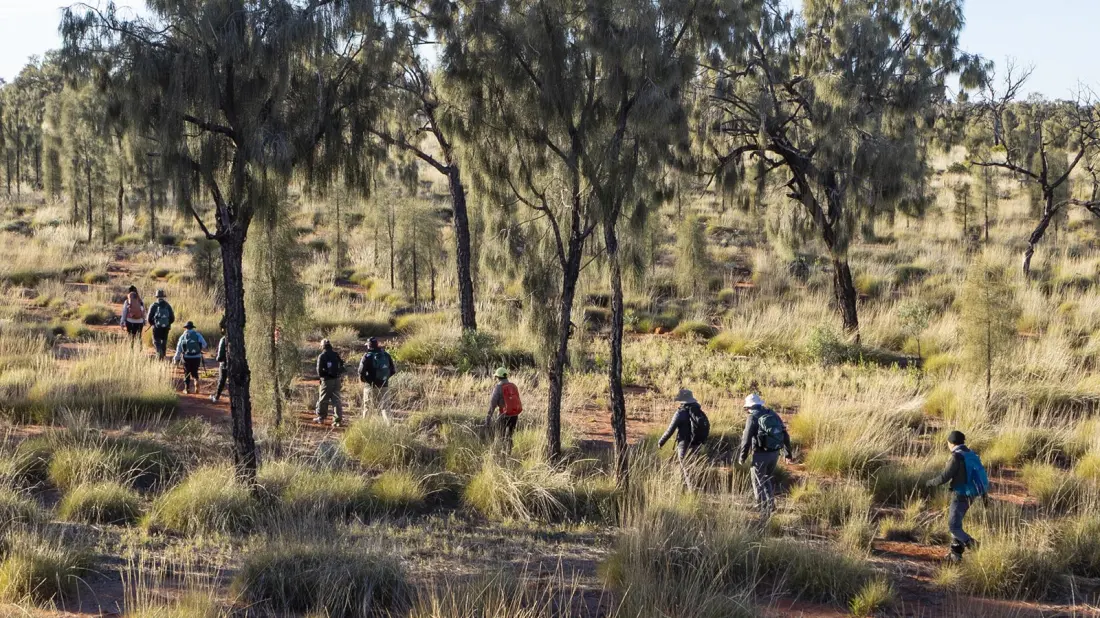
The walk runs from Kata Tjuṯa ('many heads' in Pitjantjatjara) east to Uluṟu through Country previously closed to tourists. It starts with a hike through Kata Tjuṯa's Valley of the Winds, then crosses surprisingly green desert — desert oaks, mulga woodland, spinifex tussocks, flowering mulla mullas — that supports hopping mice, pygmy monitor lizards, thorny devils and even the rare night parrot. It's not empty desert at all, and that's part of the revelation.
Accommodation steps up as you go. The first camp, Tjakuṟa, is 'comfort rather than luxury': double-mattress beds, doonas, and dinner under the stars (pumpkin risotto was on the menu reviewed here). Camp two, Taliwanu ('moving dunes'), adds enclosed communal space, Aṉangu artworks, floor-to-ceiling windows framing Kata Tjuṯa, and warm foot-soak tubs with drinks in hand after an 18-kilometre day. Nights three and four are at Mala Lodge, named for the endangered rufous hare-wallaby bred in a protective enclosure visible from the trail — its 16 stilted rooms have king beds, ensuites, air-conditioning, plus a plunge pool, massages and views towards Uluṟu.
There are cultural ground rules. Parts of the route — notably near Kata Tjuṯa, where secret men's ceremonies continue — are no-photo zones, so hikers keep cameras packed away for the first day and a half. Three TWC stories are shared along the way, including the mala creation story, which also features in the nightly Wintjiri Wiru drone-and-laser show. Guides walk the group in single file, an Aṉangu practice that protects small creatures: one hiker nearly stepped on a cold, torpid earless dragon in the pre-dawn dark.
When to go? The writer hiked in July, during Wari, the coldest of the five Aṉangu seasons — frosty mornings, pleasant daytime temperatures, little rain and, crucially, far fewer flies than in the warmer months. Dawn starts by headtorch deliver you to dune-top viewpoints for sunrise between the two rock formations, with the Milky Way still arcing overhead.
This suits travellers who want guided comfort-trekking with genuine cultural depth, not a tick-box visit to a car park viewpoint. You'll earn Uluṟu with your legs, learn which stories belong only to Country, and accept that some views are meant to stay unphotographed — arguably the most memorable part of the trip.