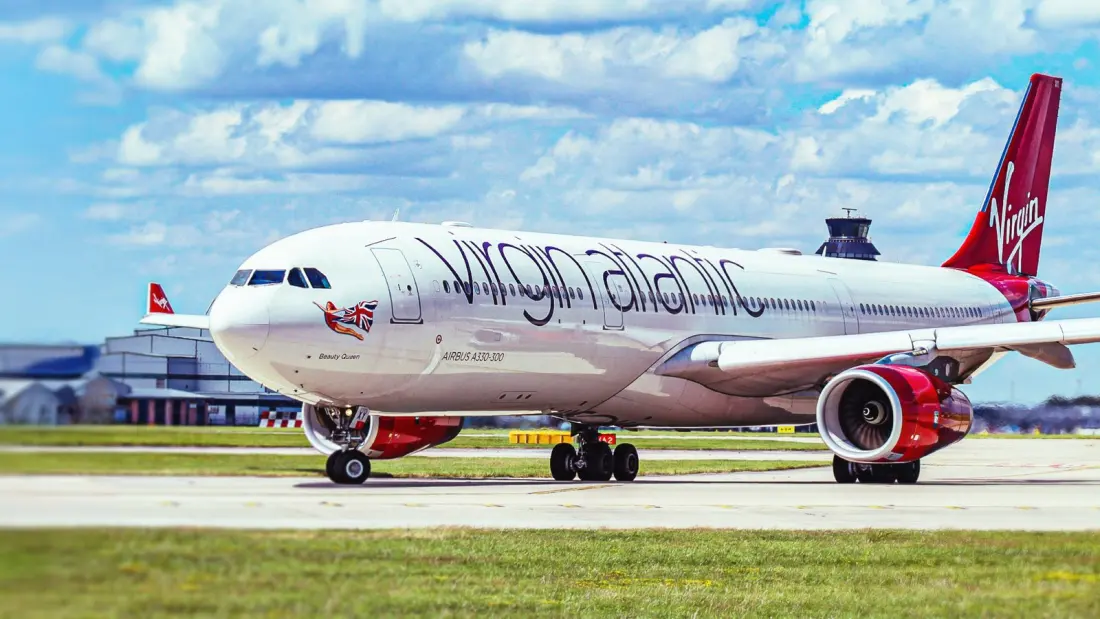
Book a London-to-Detroit flight with Virgin Atlantic these days and you may well find yourself in a Delta seat. The same goes for Chicago O'Hare and Newark. It is not a booking glitch — it is a decade-old strategy working exactly as designed.
Since 2013, Virgin Atlantic and Delta have run an antitrust-immunized joint venture covering all non-stop flights between the UK and North America. Costs and revenue are pooled 'metal-neutral': Virgin earns from a Delta-operated Heathrow-to-Detroit flight just as it would from its own. So when flying its own aircraft stops making sense, Virgin hands the route over and still collects its share.
The logic is mostly about hubs and aircraft. Detroit is a Delta fortress hub with domestic feed from more than 100 US connections; Virgin has none of its own there. Filling a 258-seat 787-9 into a market that depends almost entirely on local London traffic is a losing bet. Virgin's fleet of 43 widebodies is also unusually premium-heavy — its A350-1000s carry 44 Upper Class suites, which need high-yielding business travellers to pay off. Delta's 767s and A330s, with 26 or 34 Delta One seats, are better shaped for mixed corporate and connecting traffic. Better to let Delta fly it.
The Austin experiment showed the downside of going it alone. Virgin launched Heathrow–Austin in May 2022 with four weekly 787 flights, betting on Texas's tech sector. When corporate travel budgets shrank to roughly 70% of pre-pandemic levels, the route had no hub feed to backfill seats — and British Airways, with a daily service and a 58% booking share, crushed it. Virgin pulled out by January 2024, left with about 5% of bookings via partners.
So the airline now concentrates its fleet where premium demand is guaranteed: over 8,000 flights a year across 13 core North American gateways, with big A350 deployments on Heathrow–New York and Orlando, plus a 17% capacity boost on Manchester–Orlando for 2026. Travellers to secondary cities like Chicago, Newark, Detroit or Vancouver still book through Virgin on a single codeshare ticket — the money just flows into the same joint venture pool, worth some $13 billion.
For flyers, the practical takeaway is simple: the Virgin product experience depends on the route. On trunk routes like Heathrow–JFK you get the full Upper Class A350 experience; on partner-operated city pairs you get Delta's cabins and service instead. For Virgin, the bet is that a focused, premium-heavy fleet beats prestige flying on routes that lose money — though some argue it risks turning the airline into a boutique London brand. With seven new A330-900neos arriving in 2027-28 and 14 787-9s being retrofitted with more Upper Class seats, that question is far from settled.