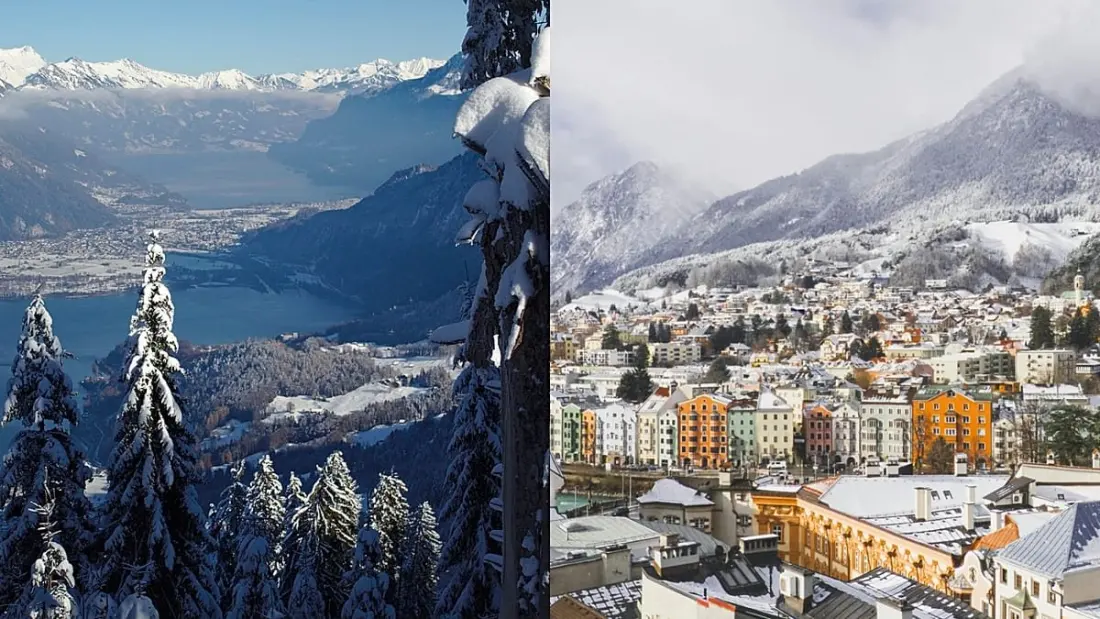
Alpine winters tend to revolve around skiing, but Interlaken in Switzerland and Innsbruck in Austria both build a whole cold-season holiday around much more than pistes. Roughly 370 kilometres apart, they're rival claimants to the adventure-traveller's winter calendar — and the differences between them are bigger than you might expect.
Interlaken sits between Lake Thun and Lake Brienz in the Bernese Oberland, and its selling point is variety. Skiing and snowboarding are spread across five areas in the Interlaken Holiday Region: Beatenberg-Niederhorn, Brienz-Axalp, Diemtigtal, Habkern and Aeschi-Aeschiried. Habkern is small and simple — one lift serving four pistes of mixed difficulty — while Aeschi-Aeschiried's slopes look out over Lake Thun towards the pyramid-shaped Niesen peak.
Then it gets interesting. The region keeps 220 kilometres of winter hiking trails maintained through the season, including a circular Aeschi route with near-constant views of the Niesen. Winter cyclists can join "Winterlaken", a two-hour guided e-bike tour by Yellow Velo that loops in the old town, 13th-century castle ruins and the village of Bönigen. On Lake Brienz itself, outfitters run half-day winter kayaking and surf-ski sessions on the famously turquoise water, dry suits provided.
Getting there requires a small trade-off: Interlaken has no airport. Bern is around 50 kilometres away, Zürich about 135, but trains from major Swiss cities run every half hour.
Innsbruck, capital of Tyrol and often dubbed the "capital of the Alps", plays a different hand. Its signature thrill is tobogganing: the Kühtai resort has Tyrol's highest run, starting at 2,127 metres and stretching 2,020 metres down, reachable after a 45-minute ascent — and floodlit after dark, so the fun doesn't stop at sunset. Cross-country skiers get nearly 40 trails in the region, including the free Panoramaloipe at Rinn, which climbs through fields to Judenstein at 900 metres.
The city also has one properly striking landmark: the Bergisel Ski Jump, a 50-metre tower redesigned by Zaha Hadid. Even non-jumpers can ride up for the view or eat at Bergisel Sky, a restaurant wrapped in floor-to-ceiling glass. For refuelling after a day on the snow, the Graf Ferdinand Haus mountain hut (open December to April) does a "hot stone" dining concept, meat and cheese fondue and spare ribs on a sun terrace.
On access, Innsbruck wins outright. It has its own airport served by around 50 airlines, including Lufthansa, British Airways, easyJet, Finnair and Icelandair, plus a coach terminal and frequent trains — Vienna runs 20 times a day, with direct services from Venice and Frankfurt.
So which one? Interlaken suits travellers who want a gentler, mixed-activity week — lakes, trails, e-bikes and smaller ski areas — and don't mind a transfer. Innsbruck is the pick for proper alpine thrills, evening tobogganing and easy flights. Accommodation-wise, both offer something unusual: Interlaken has mountain-perched wellness hotels and campsites for campervans and bungalows, while around Innsbruck you can stay in farmers' apartments or high-altitude mountain lodges. Either way, winter in the Alps doesn't have to mean skis-only.