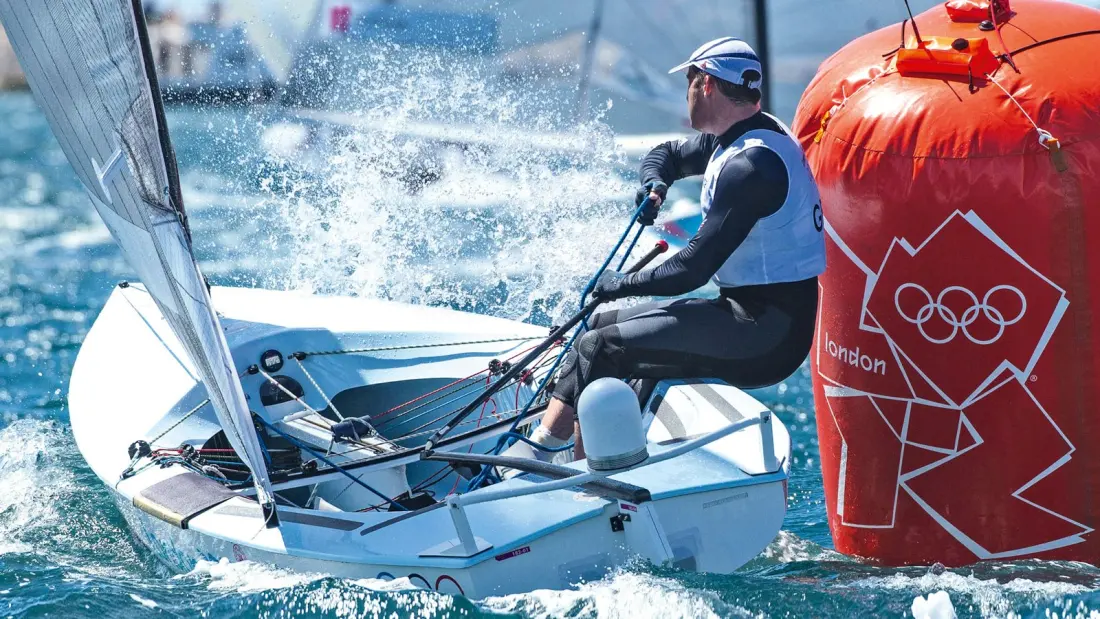
A 4.5m single-hander with no berths, a top speed of 15 knots and an adrenalin rating of 80% — the Finn dinghy has earned its spot in Yachting World's 'world's coolest boats' series, as chosen this time by British sailing legend Keith Musto.
The Finn first launched in 1949 and served as an Olympic class from 1952 through to 2020, in its later years doubling as the 'men's heavyweight dinghy'. It's a demanding boat: a big sail plan on a small hull means the sailor's weight, strength and technique matter as much as the hardware. Second-hand examples change hands for roughly £5,000-£15,000, which is remarkably accessible for a former Olympic class.
Musto's own history with the boat is a story of ingenuity over brute force. Moving into the Finn in the early 1960s at just 10½ stone and 5ft 8in, he was far too light for a class designed around heavier sailors. His response was to out-engineer the problem. He built a leaf-spring boom that automatically eased the mainsail as wind strength built, working in tandem with the mast's bend. He also invented a universal joint tiller extension fitting — an early version of the fitting that has since gone onto thousands of dinghies worldwide.
He says the Finn is the boat that taught him the most, and the lesson went beyond boat handling. Lacking the weight to win on physicality alone, he trained hard on stamina and fitness — almost unheard of among sailors at the time. That mindset carried him to a silver medal at the 1964 Tokyo Olympics in the Flying Dutchman class, and later to founding Musto, the sailing and outdoor clothing brand. He won the first-ever Endeavour Trophy in 1961 and, notably, is still sailing at 90.
For anyone curious about dinghy sailing, the Finn is a compelling entry point into the sport's history. It rewards cleverness as much as muscle, its second-hand prices won't break the bank, and sailing clubs across the UK and Europe still have active fleets and enthusiastic owners happy to show newcomers the ropes. You won't sleep aboard — the boat has zero berths — but as a workout with a hull attached, few boats match it.