Brazil's headline natural attractions are usually sold as daytime experiences: thundering water, clear rivers, wildlife on the move. But two of the country's best-known regions are now making a case for staying out after sunset, with organised stargazing programmes that fold the night sky into the wider trip.
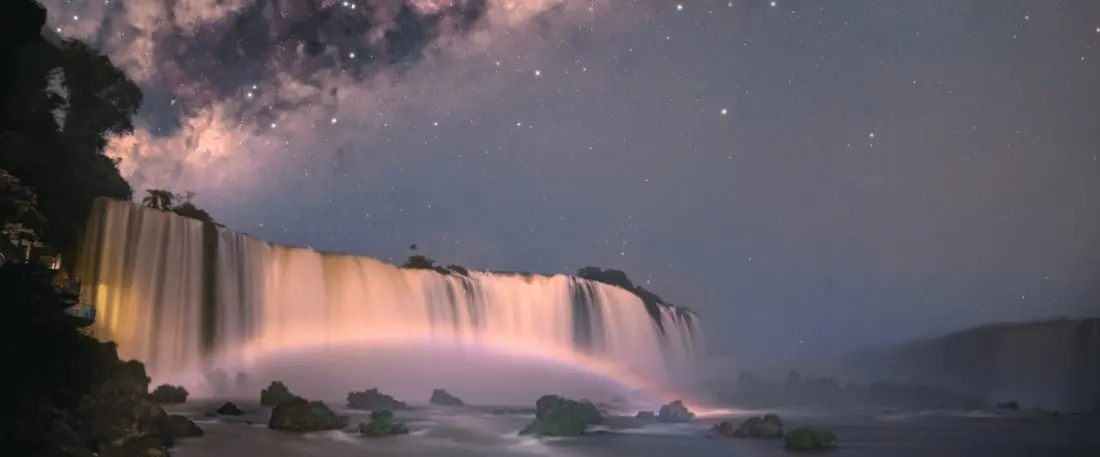
In Foz do Iguaçu, the event Céu das Cataratas runs inside Iguaçu National Park, giving visitors a rare chance to look up at the stars from a vantage point above Iguassu Falls. Because the park is a protected area with almost no urban light interference, sky conditions are unusually good for a site so close to a major tourist hub. The sessions go beyond simple stargazing: guides cover stars, planets, galaxies and how the universe formed, and weave in Guarani cultural perspectives on the sky. The result is a destination that reads completely differently at night — the same landscape defined by enormous water volume by day becomes a dark-sky amphitheatre after hours.
Further west, Mato Grosso do Sul is adding astronomy to its ecotourism mix. Bonito and the Serra da Bodoquena are famous for crystal-clear rivers, caves and waterfalls, and the region's distance from big-city lighting makes it a natural fit for spotting stars, planets and satellites. The district of Morraria do Sul, in the Serra da Bodoquena, has elevated, open ground with wide horizons and low light pollution — ideal conditions for a proper look at the night sky.
The sky is also being worked into activities the region already offers. Nighttime horseback rides cross Cerrado terrain under moonlight and stars, while night safaris in the Pantanal pair wildlife spotting with the sheer scale of the Pantanal sky. For travellers who thought the Pantanal was strictly a dawn-and-dusk proposition, that opens up a whole extra shift of the day.
The common thread is that astrotourism here isn't a standalone gimmick. It's being layered onto established nature destinations so visitors get a second, slower experience of the same place — contemplative rather than adrenaline-driven, and often carrying a cultural or scientific angle as well. For anyone planning a Brazil itinerary built around Iguassu or Bonito, it's a reason to add an overnight stay rather than passing straight through.