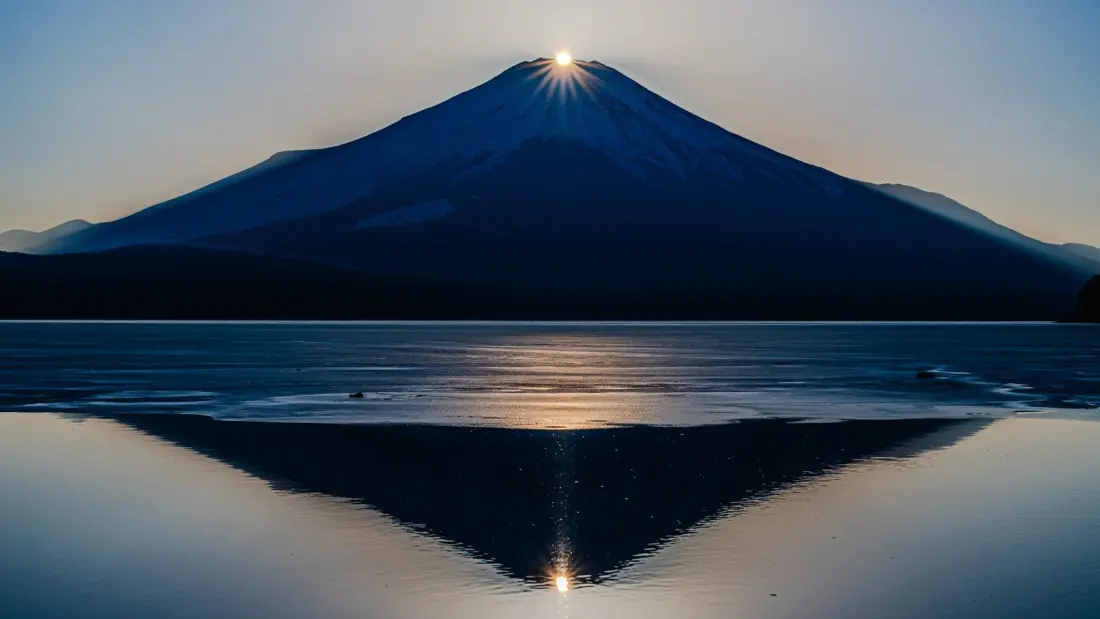
Everyone photographs Mt. Fuji from Kawaguchiko. Locals and in-the-know travellers head one lake over. Lake Yamanaka, the largest of the Fuji Five Lakes, sits about 90 minutes by car from Tokyo, with clear water, a small village atmosphere, and some of the best views of the volcano anywhere in the region.
The lake's signature spectacle is Sakasa Fuji — the mountain reflected upside-down in still water. Even rarer is Double Diamond Fuji, when the rising or setting sun sits directly above the summit and its reflection appears in the lake at the same time. Photographers time trips around Diamond Fuji Week in February; the best vantage points are the Panorama Viewpoint and Nagaike Waterfront Park. Come autumn instead and you get maple colour from mid-October to mid-November, plus evening illuminations of the foliage.
The village of Yamanakako, home to fewer than 6,000 people, circles the lake with an eight-mile, mostly paved loop trail that's made for walking or cycling — swans, cafés and all. To the north lies Oshino, one of the villages inscribed in Fuji's UNESCO World Heritage listing. Its star attraction is Oshino Hakkai, eight spring-fed ponds filled with Fuji snowmelt, framed by thatched-roof farmhouses, koi and (in spring) cherry blossoms. Shinto shrines dot the shores, and Yamanakako's Hananomiyako Park explodes into more than 70 acres of flowers each spring. August brings the Houko-sai Fireworks Festival; February's Ice Candles Festival lights frozen candle sculptures in front of the mountain.
Where to stay depends on your style. Kozanso Campground keeps things simple with quiet lakeside tent sites, communal toilets and hot showers. Next door, the four-star-rated Odakyu Yamanakako Forest Cottage offers auto camping, bungalows and a private pier. Book ahead — spots go fast. For comfort, Hotel Mt. Fuji perches on a hill above the lake with an open-air onsen facing the mountain, while Glamping Village Totonoi does air-conditioned dome tents with Japanese barbecue dinners and a sauna thrown in.
Driving is the easiest way in, and rental cars are genuinely recommended — local buses are sparse. Car-free travellers can still manage: highway buses run from Shinjuku or Tokyo Station in under three hours, and the Kawaguchiko-Gotemba-Mishima line circles the lake's southern and western edges every 30 to 60 minutes, conveniently also connecting you to Kawaguchiko for comparison.
Why choose Yamanakako over its famous neighbour? Fewer crowds, a real village to base yourself in, and the space to slow down — camp, paddle, fish or cycle with Fuji filling the horizon. It suits travellers who've done Tokyo's highlights and want a low-key nature break, or anyone chasing that one perfect reflection shot without jostling a hundred tripods. Water sports, easy trails, hot springs and glamping mean it works for couples, families and solo campers alike. Pair it with a day at Kawaguchiko or the Fuji area's theme parks and you've got a well-rounded few days without ever needing to rush.
Story via Islands.